

Introduction.
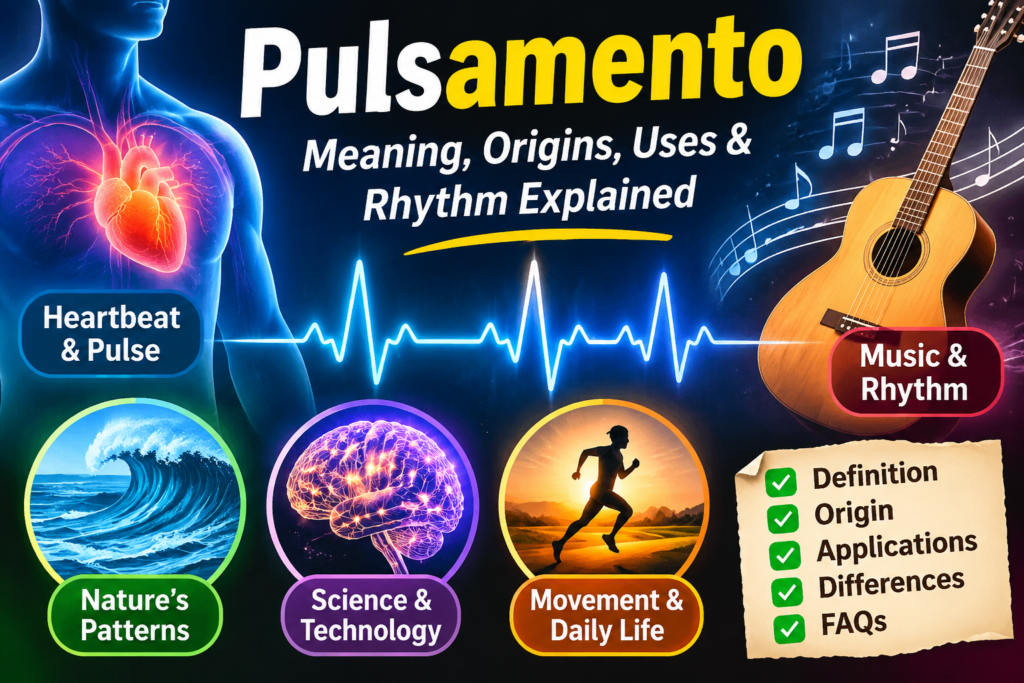
Language is full of interesting words that describe movement, sound, energy, and the patterns we experience in everyday life. Some terms have clear dictionary definitions, while others appear in modern discussions and develop different meanings depending on their context. Pulsamento is one such interesting term that has attracted attention in online articles and discussions about rhythm, music, movement, and natural patterns.
The word Pulsamento is generally used in online content to describe a pulse-like sensation, repeated movement, rhythmic beating, or continuous flow. It is often associated with ideas such as heartbeat, musical timing, vibration, and the natural repetition of events. However, it is important to understand that it is not a widely standardized English scientific or medical term. More established English expressions include pulse, pulsation, beat, and rhythm.
Understanding Pulsamento requires looking beyond a single definition. Its meaning can be interpreted through different subjects, including music, language, biology, art, and technology. These areas share an important feature: they all involve patterns that repeat over time.
For example, a heartbeat follows a repeated biological pattern, music develops through organized beats, and a vibrating object produces repeated physical movement. These examples help explain why writers sometimes use the term to describe a broader idea of rhythm and repetition.
This guide explores the possible meaning of Pulsamento, its linguistic background, its relationship with music and natural rhythms, and the differences between it and more established terms. It also examines common misconceptions and explains how the concept can be understood through practical examples.
1. What Is Pulsamento?
Pulsamento is a term used in some online discussions to describe a repeating pulse, rhythmic movement, or continuous pattern. Its interpretation usually depends on the subject in which it appears.
In simple language, Pulsamento can be understood as the idea of something moving, beating, or repeating in a recognizable pattern. This interpretation connects it with familiar experiences such as listening to a drumbeat, noticing a heartbeat, or observing waves moving toward a shoreline.
Unlike established scientific terminology, Pulsamento does not have one universally accepted technical definition. Different writers may use it in different ways, so readers should consider the surrounding context before deciding what the word means.
Pulsamento Meaning in Simple English.
The easiest way to understand Pulsamento is to think about repetition. When something produces a regular beat or repeating movement, it creates a pattern that can often be heard, seen, or felt.
Consider a clock ticking every second. Each tick is a separate sound, but the repeated sequence creates a steady rhythm. A person listening to music may experience something similar when tapping their foot along with a song.
A heartbeat is another familiar example. The heart contracts and relaxes in a repeating cycle, producing a pulse that can be measured.
These examples illustrate the broader concept associated with Pulsamento. They do not mean that the word is an official name for every type of rhythmic activity.
The Basic Idea Behind Pulsamento.
Three related ideas help explain the term:
- Pulse: A repeated beat or signal that occurs over time.
- Rhythm: An organized pattern of sounds, movements, or events.
- Vibration: Repeated physical movement around a position.
These concepts overlap, but they are not identical. A pulse can provide a regular foundation, while rhythm describes how different events are arranged around that foundation.
For example, a drummer may maintain a steady beat while playing different rhythmic patterns. The beat remains consistent even when the music becomes more complex.
Why People Are Searching for Pulsamento.
Uncommon words often attract attention because people encounter them in articles, search results, social media posts, or online discussions.
Pulsamento is interesting because its spelling resembles established words associated with pulsing and pulsation. Readers may naturally want to know whether it is a dictionary word, a musical expression, or a technical term.
Another reason for this curiosity is that different websites sometimes explain the term in different ways. Some focus on music, others discuss natural movement, and some connect it with the human body.
The best approach is to examine each use carefully instead of assuming that every explanation describes an officially recognized concept.
2. Origin and History of Pulsamento.
The linguistic background of Pulsamento requires careful explanation because similar-looking words do not automatically share the same documented history.
The established English word pulsation has a traceable history connected with Latin. The Online Etymology Dictionary explains that pulsation comes from Latin pulsatio, meaning a beating or striking, and is associated with the verb pulsare, meaning to beat, strike, or push against something.
However, this documented history does not independently establish the exact origin of Pulsamento. A direct historical connection should not be presented as certain without reliable linguistic evidence.
Linguistic Roots of Pulsamento.
The word resembles several established terms used in Romance languages. These languages contain vocabulary connected with beating, striking, pressing, and rhythmic movement.
For example, Italian uses pulsazione, Spanish uses pulsación, and Portuguese uses pulsação. These words are associated with pulsation or beating.
Their similarities help explain why Pulsamento may sound familiar to people who recognize vocabulary connected with pulse and movement.
Nevertheless, similar spelling is not sufficient evidence to establish that Pulsamento is a standard word in any particular language.
Connection With the Latin Word Pulsare.
The Latin verb pulsare is important when studying the history of English words such as pulse and pulsation.
Its meaning includes beating, striking, and repeatedly pushing against something. The idea of repeated action helps explain how related vocabulary developed meanings associated with heartbeats and rhythmic movement.
For instance, the English word pulsation describes a repeated beating or throbbing action. It can also describe vibration or recurring changes in physical conditions.
This connection provides useful linguistic background for understanding why people associate Pulsamento with pulse-like movement.
However, a distinction must be maintained between the documented origin of pulsation and the uncertain history of Pulsamento itself.
How the Term Appears in Modern Language.
In contemporary online writing, Pulsamento is sometimes used as a broad descriptive expression.
Writers may use it to discuss:
- Repeating musical beats.
- Rhythmic movement.
- Natural cycles.
- Heartbeat-like patterns.
- Repeated physical vibrations.
- Creative expressions of energy and motion.
These examples demonstrate how the word is interpreted in different contexts. They should not be confused with proof that it has become an official term in each of these fields.
3. Is Pulsamento a Real Word?
One of the most common questions about Pulsamento concerns its status as a real word.
The answer depends on what someone means by real. A word can appear in published writing and communicate an understandable idea without being a standardized dictionary entry or recognized technical term.
Pulsamento appears in online English-language content, but its usage is not as established as words such as pulse, pulsation, beat, and rhythm.
Is Pulsamento an Official English Word?
Pulsamento is not a widely recognized standard English dictionary term. English speakers generally use pulse or pulsation when describing a repeated beat or throbbing movement.
That does not prevent writers from using Pulsamento creatively. New expressions and borrowed terms sometimes appear in articles, discussions, and branding.
However, an article that explains the word should clearly distinguish between informal usage and established English vocabulary.
For readers looking for a precise definition, pulsation is usually the more suitable English word.
Is Pulsamento a Scientific or Medical Term?
Pulsamento is not an established medical diagnosis or standard clinical measurement.
Healthcare professionals generally use recognized terminology such as:
- Pulse.
- Heart rate.
- Heartbeat.
- Pulsation.
- Palpitations.
- Blood pressure.
These terms have specific meanings in medical communication.
For example, heart rate describes how many times the heart beats within a minute. Palpitations refer to the sensation of being aware of one’s heartbeat, such as feeling that the heart is racing, pounding, or fluttering.
Therefore, Pulsamento should not be presented as a disease, medical condition, or scientifically established treatment.
Why Its Meaning Can Vary.
The meaning of an unfamiliar word can change depending on how different writers use it.
There are several reasons why Pulsamento may have different explanations online.
First, the term resembles words in several languages that are connected with pulse and pulsation. This creates a natural association with rhythmic activity.
Second, online publishers may use the word as a broad subject covering music, wellness, creativity, or technology.
Third, articles sometimes repeat definitions from other websites without providing reliable linguistic or scientific references.
For this reason, understanding the context is essential. Readers should identify whether an article is discussing a creative expression, a musical idea, or a measurable physical process.
4. Pulsamento in Music and Rhythm.
Music provides one of the easiest ways to understand the general idea associated with Pulsamento.
Every musical performance depends on timing. Notes, pauses, accents, and beats work together to create an organized listening experience.
A steady musical pulse gives performers and listeners a sense of movement. Even when a song includes complicated rhythms, an underlying beat often helps people follow its structure.
Understanding Musical Pulse.
A musical pulse is the regular underlying beat that helps organize musical time.
Imagine listening to a simple song and tapping your hand against your knee. If you continue tapping at a consistent speed, you are following its basic pulse.
Musicians use this internal sense of timing to coordinate their performances.
For example, a guitarist playing with a drummer must understand where the beats occur. If one performer consistently moves ahead or falls behind, the performance may lose its coordination.
The broader idea associated with Pulsamento can be used informally to describe this continuing sense of rhythmic movement.
Pulsamento and Musical Timing.
Musical timing determines when individual notes and sounds occur.
A song may have a steady beat, but its melody can contain long notes, short notes, pauses, and unexpected accents. These variations create musical interest.
Good timing allows performers to place these sounds accurately.
Consider a simple four-beat musical pattern:
- The first beat establishes the beginning.
- The second beat continues the pattern.
- The third beat provides another rhythmic point.
- The fourth beat completes the cycle before the pattern repeats.
This structure makes it easier for musicians to understand musical organization.
Its Connection With Guitar and Instrumental Music.
Guitar players rely heavily on rhythm and timing.
Whether someone is playing classical guitar, acoustic music, or modern instrumental arrangements, maintaining a consistent pulse is important.
A guitarist may use fingerpicking, strumming, or individual notes to create different patterns. Each technique requires coordination between the hands.
In online discussions, Pulsamento may be used to describe the feeling of maintaining an internal pulse while playing. However, it should not automatically be described as a standardized guitar technique.
Established guitar terminology is more useful when explaining specific techniques, hand movements, or performance instructions.
Difference Between Beat, Rhythm, and Tempo.
These three terms are closely connected but describe different aspects of music.
Beat: The regular underlying unit of musical time.
Rhythm: The arrangement of sounds and silences over time.
Tempo: The speed at which the beat occurs.
For example, a song can have a slow tempo but a complex rhythm. Another song may have a fast tempo and a very simple rhythmic structure.
Understanding these differences makes discussions about Pulsamento and musical expression more accurate.
5. Pulsamento and the Human Body.
The human body contains many natural rhythms. Some are easy to notice, while others occur automatically without conscious attention.
Breathing, heartbeats, and sleep-wake cycles are examples of biological processes that follow repeating patterns.
These processes provide useful comparisons when discussing the general idea of Pulsamento.
Connection With Heartbeat and Pulse.
The heart continuously pumps blood throughout the body. Its contractions create pressure changes that can be detected as a pulse in certain arteries.
People commonly check their pulse at the wrist or neck.
A pulse provides information about heart rate and the timing of individual beats. Healthcare professionals may also assess its regularity and strength.
Although Pulsamento can be used informally to describe a heartbeat-like pattern, it is not the clinical term for measuring heart activity.
Rhythmic Breathing and Body Movement.
Breathing follows a repeated cycle of inhalation and exhalation.
During normal breathing, air moves into the lungs and then moves out again. The process continues automatically, although people can also control their breathing consciously for short periods.
Physical movement also contains repeated patterns.
Walking, running, swimming, and cycling all involve movements that repeat in a coordinated sequence.
For example, walking requires alternating movements of the legs. Once a person develops a comfortable pace, the body naturally maintains a repeating pattern.
These examples help illustrate the relationship between movement and rhythm without treating Pulsamento as a medical or physiological principle.
Understanding Natural Body Rhythms.
Biological rhythms occur throughout the human body.
One important example is the circadian rhythm, which helps regulate the sleep-wake cycle over approximately 24 hours.
Other biological processes follow different time patterns. Heart rate changes with activity, while breathing speed can change during exercise or relaxation.
These systems demonstrate how the body coordinates repeated activities.
When discussing Pulsamento in relation to human biology, it is more accurate to use established scientific terms for specific processes.
6. Different Applications of Pulsamento.
The term Pulsamento is sometimes used in a broad descriptive sense. Its possible applications depend on the meaning intended by the writer.
The following examples explain how pulse-like repetition can appear in different areas of life.
Pulsamento in Nature.
Nature contains many repeating patterns.
Ocean waves move toward the shore and return. Rain may fall in repeated bursts. Some animals follow regular movement patterns, while seasonal changes occur in recurring cycles.
These examples demonstrate the presence of rhythm in the natural world.
For instance, the movement of ocean waves can create a continuous visual pattern. Their speed and size may change depending on wind, weather, and other environmental conditions.
A writer may describe this experience using Pulsamento as a creative expression for repeating movement.
However, ocean waves are physical processes that are better explained through established scientific vocabulary.
Pulsamento in Art and Creative Expression.
Artists often use repetition to communicate energy, movement, and emotion.
A painting may include repeated lines or shapes. A poem may use recurring sounds. A dance performance may build around repeated movements.
These creative techniques help establish visual or emotional rhythm.
Writers can use Pulsamento metaphorically when describing a work that feels energetic or continuously moving.
For example, a poem with repeated phrases may create a strong rhythmic effect. Similarly, a painting with recurring circular shapes may suggest motion.
In this context, the term is best understood as a descriptive or artistic expression rather than a formal artistic method.
Pulsamento in Technology.
Technology also uses repeated signals and patterns.
Electronic devices rely on signals to transmit information, coordinate operations, and control different functions.
A digital system may generate repeated electrical pulses. Communication systems can use timed signals to transfer information between devices.
A blinking indicator light is another simple example of repetition. Its repeated flashing can show that a device is active or waiting for an action.
However, engineers generally use more precise terms such as pulse signal, frequency, waveform, and oscillation.
Pulsamento may be used informally to describe a repeating technological pattern, but it is not a substitute for technical terminology.
Pulsamento in Everyday Life.
Many daily activities involve repetition.
A person may follow a regular walking pace, prepare breakfast at a similar time, or listen to music while working.
These routines create predictable patterns that make daily life easier to organize.
People also recognize repetition in familiar sounds, including clocks, footsteps, fans, and musical instruments.
Thinking about these examples can make the broader idea behind Pulsamento easier to understand.
7. Pulsamento vs Pulse vs Pulsation vs Rhythm.
Although these terms are related, they should not be treated as interchangeable.
Understanding their differences is important for accurate communication.
| Term | Meaning | Common context |
|---|---|---|
| Pulsamento | Informal expression for pulse-like repetition | Online writing and creative descriptions |
| Pulse | A regular beat or signal | Biology, medicine, and electronics |
| Pulsation | Rhythmic throbbing or repeated vibration | Science and general English |
| Rhythm | An organized pattern of events | Music, movement, and daily activities |
| Beat | A regular unit of musical time | Music |
| Tempo | The speed of a musical beat | Music |
| Oscillation | Repeated movement or variation | Physics and engineering |
Key Differences Explained.
Pulse usually describes a repeated beat or a brief signal. In biology, it can refer to the pressure wave produced by the heart’s activity.
Pulsation describes rhythmic throbbing or vibration. It can be used in physical, biological, and general descriptive contexts.
Rhythm refers to an organized pattern of sounds, movements, or events.
Beat is particularly important in music because it provides a regular foundation for timing.
Tempo describes how quickly or slowly the beats occur.
Pulsamento, in comparison, is less standardized. Its meaning depends on the context in which it appears.
Similarities and Common Uses.
The terms share an association with repetition and movement.
For example, a musical performance may contain a steady pulse, a recognizable rhythm, and a particular tempo.
A person’s heartbeat may also be described through pulse and pulsation.
The important difference is that each established word communicates a more specific idea.
Which Term Should You Use?
The best word depends on the subject.
Use pulse when discussing a heartbeat or repeated signal.
Use pulsation when describing rhythmic throbbing or vibration.
Use rhythm when explaining patterns in music, movement, or sound.
Use beat and tempo when discussing musical timing.
Pulsamento may be appropriate in creative writing when its intended meaning is explained clearly.
8. Why Is Pulsamento Gaining Attention Online?
Unusual keywords sometimes receive attention because readers want to understand unfamiliar expressions.
Pulsamento has appeared in online articles covering subjects such as rhythm, music, language, creativity, and natural movement.
However, increased online publication does not necessarily mean that a word has become an officially recognized scientific concept.
Growing Interest in Uncommon Keywords.
People regularly search for unfamiliar words after seeing them in an article, social media post, or online discussion.
They may want to know its meaning, origin, pronunciation, and correct usage.
Pulsamento creates curiosity because it resembles familiar vocabulary while appearing in different subject areas.
This makes it an interesting topic for educational content.
Digital Content and Modern Language.
Digital publishing allows new expressions to spread quickly.
Blogs, online magazines, educational websites, and social media platforms introduce readers to vocabulary they may not encounter in traditional dictionaries.
Some expressions become widely accepted over time, while others remain informal or limited to particular communities.
Pulsamento is best approached with this distinction in mind.
Social Media and Online Discussions.
Social media encourages people to share short explanations and unusual words.
A term may appear in a post, become part of a discussion, and eventually receive attention from publishers.
Readers should still evaluate the information they encounter.
An explanation supported by dictionaries, linguistic references, or scientific sources is generally more reliable than an unsupported statement repeated across multiple websites.
9. Benefits of Understanding Pulsamento.
Understanding the general concept associated with Pulsamento can help readers recognize how repetition and rhythm influence different activities.
The value comes from understanding established ideas about pulse, timing, and patterns rather than treating the word itself as a proven scientific system.
Understanding Rhythm and Repetition.
Recognizing repeated patterns is useful in many situations.
People identify rhythms in music, movement, speech, and everyday activities.
For example, recognizing a repeated pattern in a song can make it easier to follow the music and anticipate what happens next.
The same ability can help people understand repeated sequences in visual art and movement.
Improving Musical Awareness.
Musical awareness involves recognizing different elements of sound.
These include beat, tempo, rhythm, melody, and changes in volume.
A person who practices listening carefully may become better at identifying when a beat changes or when an instrument introduces a new pattern.
Following a steady pulse can also help beginner musicians improve timing and coordination.
Recognizing Patterns in Everyday Activities.
Patterns are present in many ordinary experiences.
A regular walking pace, a repeated work routine, and the sound of a clock are simple examples.
Recognizing these patterns can help people understand how different activities are organized.
This is one reason rhythm is an interesting subject beyond music.

10. Common Misconceptions About Pulsamento.
Because Pulsamento is not a widely standardized term, different explanations can create confusion.
Readers should separate creative interpretations from documented facts.
Is Pulsamento a Medical Treatment?
No established evidence identifies Pulsamento itself as a recognized medical treatment.
Some online content may connect the word with relaxation, wellness, or natural body rhythms. Such descriptions should not be interpreted as proof of a clinical therapy.
Medical treatments require appropriate scientific evaluation and reliable evidence.
Is It an Established Scientific Theory?
Pulsamento is not a recognized scientific theory.
Science uses established concepts to describe repeated motion, signals, frequencies, and biological rhythms.
For example, oscillation describes repeated movement or variation, while frequency measures how often an event repeats during a specified period.
These concepts have precise meanings that should not be replaced with an informal expression.
Does It Have One Universal Meaning?
No. Its meaning varies depending on how individual writers use it.
Some articles associate it with music, while others use it as a metaphor for movement or natural patterns.
The absence of one widely accepted definition makes context especially important.
11. How to Understand Pulsamento in Daily Life.
The easiest way to understand the idea associated with Pulsamento is to observe familiar patterns.
There is no special equipment or technical training required to recognize repetition.
Simple Real-Life Examples.
Consider the following examples:
A ticking clock: Each tick occurs at a regular interval, producing a repeated sound pattern.
A beating drum: The drummer creates beats that can be slow, fast, regular, or varied.
Ocean waves: Water moves repeatedly toward the shore and then retreats.
Walking: The legs move in an alternating sequence that creates a recognizable pace.
A heartbeat: The heart produces repeated contractions that maintain blood circulation.
Each example involves some form of repetition, but the underlying physical processes are different.
Recognizing Repeated Patterns.
Start by listening to a familiar song.
Try to identify the regular beat before focusing on the melody or individual instruments.
Next, observe an everyday activity such as walking. Notice how the movement repeats and how the pace changes when you move faster or slower.
You can also observe natural patterns, such as rainfall or moving water.
These simple exercises help develop an understanding of rhythm and repetition.
Applying the Concept to Music and Creativity.
Writers, musicians, and artists can use rhythmic ideas to create more engaging work.
A musician may repeat a pattern to build familiarity. A writer may repeat a phrase to create emphasis. A visual artist may arrange shapes in a recurring sequence.
These methods demonstrate how rhythm can influence creative expression.
Pulsamento can serve as an informal descriptive term when discussing this sense of movement, provided its meaning is made clear.
12. Frequently Asked Questions About Pulsamento.
What does Pulsamento mean?
Pulsamento is used in some online writing to describe a repeating pulse, beat, vibration, or rhythmic movement. It does not have one universally accepted technical definition in English.
Is Pulsamento a real English word?
It appears in English-language online content, but it is not a widely standardized English dictionary term. Pulse and pulsation are more established alternatives.
Is Pulsamento an Italian word?
Italian commonly uses the word pulsazione for pulsation. Pulsamento should not automatically be presented as the standard Italian translation without reliable dictionary evidence.
Is Pulsamento related to music?
It can be used in music-related writing to describe a steady underlying pulse or sense of rhythmic movement. However, it is not a universally recognized formal music theory term.
Is Pulsamento a medical condition?
No. Pulsamento is not an established medical diagnosis or recognized disease. Medical professionals use terms such as pulse, heart rate, heartbeat, and palpitations.
What is the difference between Pulsamento and pulsation?
Pulsation is an established English word that describes rhythmic throbbing, beating, or vibration. Pulsamento is a less standardized expression that may be used informally for similar ideas.
Can Pulsamento describe a heartbeat?
In informal writing, it may be used to describe a heartbeat-like pattern. However, pulse or heartbeat is more accurate when discussing human physiology.
Why is Pulsamento becoming popular?
The word has appeared in various online articles and discussions, creating curiosity about its meaning and origin. Its unusual spelling and connections with rhythm make it an interesting search topic.
Is Pulsamento a recognized scientific term?
It is not a widely recognized scientific term. Researchers generally use precise terminology such as oscillation, frequency, pulse, vibration, and periodic motion.
Can Pulsamento be used in creative writing?
Yes. A writer may use it as a descriptive expression for repeating movement, energy, or rhythm. The intended meaning should be clear from the surrounding text.
What is the relationship between Pulsamento and vibration?
Both ideas can be associated with repeated movement. Vibration has a specific physical meaning involving oscillatory motion, while Pulsamento is used more loosely in online descriptions.
Is Pulsamento the same as tempo?
No. Tempo describes the speed of a musical beat. Pulsamento is an informal expression that may refer to the sensation or continuation of a pulse.
Can Pulsamento describe patterns in nature?
It can be used metaphorically to describe recurring natural events such as waves, repeated movements, or seasonal patterns. Scientific explanations should use the appropriate terms for each process.
How can beginners understand Pulsamento?
Beginners can start by observing familiar patterns such as a clock ticking, music playing, or people walking. These examples make the ideas of pulse and rhythm easier to understand.
13. Final Thoughts on Pulsamento.
Pulsamento is an interesting expression because it brings attention to a familiar part of everyday experience: repetition. Music, natural movement, biological processes, and technology all contain patterns that occur over time.
Although the word is used in online discussions to describe pulse-like movement and rhythmic activity, it is important to understand its limitations. It is not a widely standardized English term, an established medical diagnosis, or a recognized scientific theory.
The more reliable vocabulary includes pulse, pulsation, rhythm, beat, vibration, and oscillation. Each term describes a particular aspect of repeated movement or activity.
Understanding Pulsamento therefore involves looking at the context in which the word appears. In music, the discussion may focus on a steady beat. In creative writing, it may describe a sense of continuous movement. In biology, more precise terms are necessary to explain the heartbeat and other body processes.
Ultimately, the concept offers an interesting way to explore how patterns connect different areas of life. By learning the differences between pulse, rhythm, and pulsation, readers can better understand the subject and use related vocabulary accurately.
Whether someone encounters Pulsamento while reading about music, language, movement, or creativity, the most important step is to consider the intended meaning and distinguish informal descriptions from established terminology.


