

Introduction.
Pulsamento is an interesting term that has attracted attention in online discussions about rhythm, movement, music, and repeating patterns. People searching for Pulsamento often want to understand its meaning, where it comes from, how it relates to musical expression, and whether it represents a recognized scientific or cultural concept.
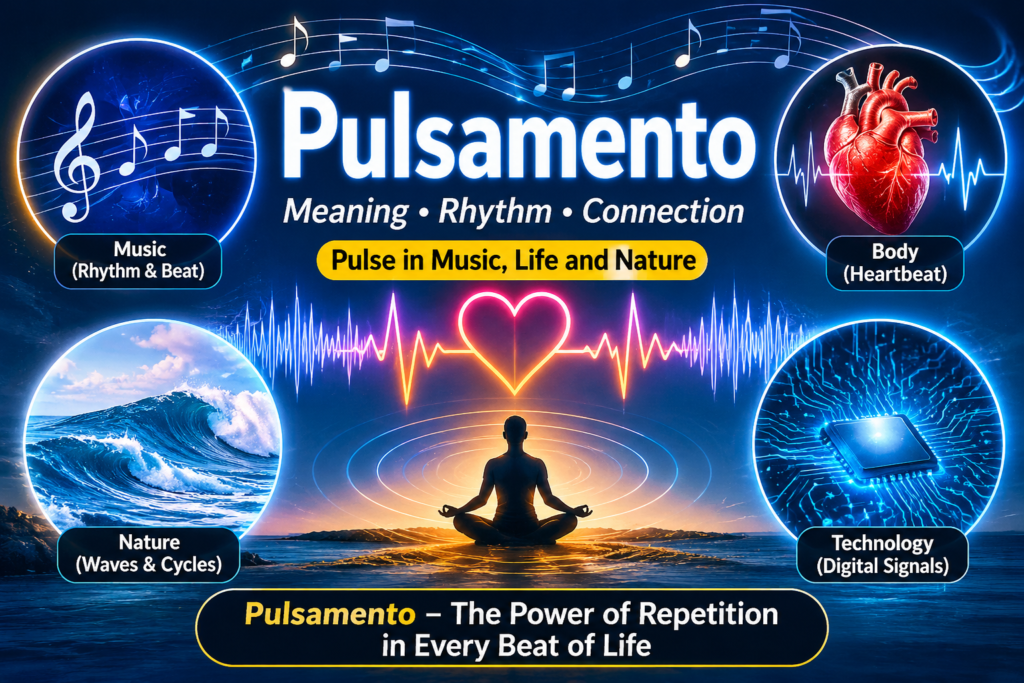
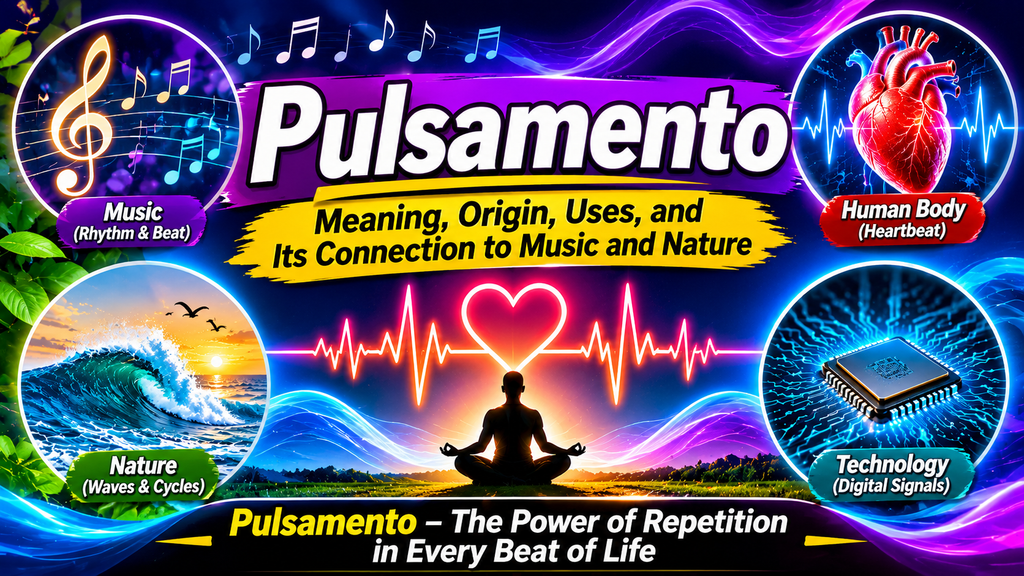
At its simplest, Pulsamento is used in some modern online writing to describe the idea of a pulse, recurring beat, vibration, or continuous rhythmic movement. It can help communicate how repeated actions create recognizable patterns in different situations. Examples include the steady beating of a drum, the movement of ocean waves, a clock ticking, and the natural rhythm of breathing.
However, it is important to understand that Pulsamento does not have one universally established definition in standard English dictionaries or scientific terminology. Established words such as pulse, pulsation, rhythm, and beat have clearer meanings and are more commonly used in professional fields.
The concept behind Pulsamento can nevertheless provide an interesting way to explore how rhythm influences music, nature, physical movement, technology, and creative expression.
This guide explains the Pulsamento meaning, possible linguistic connections, musical applications, natural rhythms, differences between related terms, and its appearance in modern online culture. It also separates established information from interpretations that should not be treated as proven facts.
What Is Pulsamento?
Pulsamento is a term used in some online articles and creative discussions to describe a repeating pulse or rhythmic pattern. Depending on the context, writers may use it when discussing sound, movement, vibration, music, and other recurring activities.
The word is closely associated in meaning with established concepts such as pulsation and rhythm. These concepts describe events that repeat over time, creating a pattern that people can hear, see, feel, or measure.
For example, imagine listening to a drum playing several evenly spaced beats. Each strike creates an individual sound, but the repeated sequence establishes a recognizable musical pulse. A similar pattern can be observed in a clock ticking or a light flashing at regular intervals.
These examples help explain the general idea behind Pulsamento.
Pulsamento Meaning in Simple English.
In simple English, Pulsamento can be understood as an informal description of repeated beating, pulsing, or rhythmic movement.
Its interpretation depends on how the writer or speaker uses it. It may describe:
- A repeating musical beat.
- A continuous rhythmic movement.
- A pulse-like vibration.
- A repeated sound pattern.
- A natural cycle or movement.
- A sequence of signals occurring at intervals.
It is not necessary to assume that every use of the term refers to the same technical process.
The Basic Idea Behind Pulsamento.
The basic idea is repetition.
When an action happens once, it is a single event. When the same action happens repeatedly, it can establish a pattern. If the events occur at recognizable intervals, the pattern may create a sense of rhythm.
For example, a musician playing a drum repeatedly creates a rhythmic sequence. A person walking produces alternating movements. Waves repeatedly approaching a shoreline create a natural pattern of movement.
These situations are different, but each involves repetition and timing.
Pulsamento is sometimes used as a broad descriptive expression for this type of experience.
Why Are People Searching for Pulsamento?
There are several possible reasons behind the interest in this keyword.
First, the word resembles familiar terms associated with pulse and pulsation. Readers may encounter it in an article and search for an explanation.
Second, online discussions use the term across different subjects, including music, nature, technology, and lifestyle content. This can make its meaning difficult to understand.
Third, people may want to know whether Pulsamento is a genuine dictionary word, a musical technique, a scientific concept, or simply a developing descriptive expression.
Understanding these differences is important before accepting any particular explanation.
Origin and Linguistic Background of Pulsamento.
Understanding the possible linguistic background of Pulsamento requires looking at related words rather than assuming that the term has one confirmed historical origin.
Several European languages contain words associated with pulsing, beating, and repeated movement. These words have connections to the Latin verb pulsare, which means to strike, beat, or push.
However, a connection between related words does not automatically establish the exact origin or official status of Pulsamento.
Connection With the Latin Word Pulsare.
The Latin verb pulsare is associated with striking, beating, or repeatedly pushing something.
This linguistic connection helps explain why several modern words relating to pulses and pulsations have similar forms.
For instance, English uses the word pulsation to describe rhythmic throbbing, vibration, or recurring changes. Italian uses pulsazione, while Portuguese uses pulsação.
These are established terms in their respective languages.
Pulsamento resembles this family of expressions, but writers should avoid presenting it as a universally standardized English translation of those words.
Pulsamento and Romance Languages.
Romance languages developed from Latin and share many related vocabulary patterns.
Italian, Spanish, Portuguese, and French contain words connected with movement, beating, and pulsation.
For example:
- Italian: Pulsazione.
- Spanish: Pulsación.
- Portuguese: Pulsação.
- English: Pulsation.
These terms provide useful linguistic context when exploring Pulsamento.
Nevertheless, their similarities should not be confused with proof that Pulsamento is an official term in all these languages.
How the Term Appears in Modern Language.
Modern internet publishing has made it easier for unfamiliar expressions to appear in different contexts.
A word may become visible through blogs, articles, creative projects, online communities, and branding.
Pulsamento is one example of a term that appears in modern online discussions without having one universally agreed definition.
As its usage develops, its meaning may depend on the subject being discussed.
For this reason, explaining the intended meaning is more useful than assigning it an unsupported historical definition.
How Does Pulsamento Work as a Concept?
The idea commonly associated with Pulsamento can be understood by studying repetition, timing, and movement.
These three elements help explain why rhythmic patterns are recognizable in music and other activities.
Understanding Pulse and Repetition.
A pulse is a repeated beat or signal that provides a recognizable point of reference.
In music, a steady pulse helps musicians maintain timing. In the human body, a pulse can be felt through the expansion of an artery caused by blood pressure changes.
In technology, electronic systems may use repeated pulses to communicate information or coordinate operations.
The exact mechanism differs between these examples, but repetition is an important shared feature.
The Role of Rhythm and Timing.
Rhythm describes the arrangement of sounds, movements, or events over time.
Timing determines when individual events occur.
For example, two musicians may play the same notes but produce different musical experiences because they organize the timing differently.
A steady underlying beat can make music easier to follow, while variations in rhythm can introduce emotion, complexity, and expression.
Pulsamento may be used informally to describe the continuous sense of movement that comes from such repeating patterns.
How Repeating Patterns Create Movement.
Repeating patterns can make an activity feel organized and predictable.
Consider a person walking at a comfortable pace. One step follows another, creating a repeating movement.
Similarly, a drummer may repeat a particular pattern to establish the foundation of a song.
Even natural events, such as ocean waves, can create a recognizable sequence of movement.
The pattern does not always need to remain perfectly regular. Small changes in speed, intensity, or timing can make it more expressive.
Pulsamento and Music.
Music is one of the most useful areas for understanding the ideas associated with Pulsamento.
Musical experiences frequently depend on beats, tempo, rhythm, timing, and repetition. These elements work together to organize sounds into recognizable compositions.
Although Pulsamento is not a universally standardized music theory term, it can be used informally to discuss the feeling of a continuous musical pulse.
The Connection Between Pulsamento and Musical Rhythm.
Musical rhythm refers to how sounds and silences are arranged over time.
A song may include long notes, short notes, pauses, repeated beats, and changing patterns.
The underlying pulse helps listeners understand the movement of the composition.
For example, a simple drum pattern may establish a regular beat. Other instruments can then create different rhythmic patterns around it.
This combination produces musical structure.
Pulsamento can serve as a descriptive expression for the sense of ongoing rhythmic movement created by these elements.
Understanding Musical Beats and Tempo.
Beat and tempo are related, but they have different meanings.
A beat is a regular unit of musical time. Tempo describes how quickly those beats occur.
Tempo is commonly measured in beats per minute, also known as BPM.
For example:
- 60 BPM represents approximately one beat per second.
- 90 BPM represents one and a half beats per second.
- 120 BPM represents two beats per second.
These measurements help musicians understand and communicate musical speed.
A slower tempo may create a relaxed atmosphere, while a faster tempo can produce excitement or energy.
How Musicians Use Rhythm and Timing.
Musicians use rhythm to create structure and communicate emotion.
A drummer may maintain a steady beat while a guitarist plays a more complicated rhythmic pattern.
A pianist may use repeated notes to create movement, while a singer may change the timing of certain phrases to express emotion.
Musical timing also helps performers work together.
When musicians maintain a shared sense of pulse, their performance becomes more coordinated.
The concept associated with Pulsamento can help describe this feeling of rhythmic continuity, even though professional musicians normally use more established terminology.
Pulsamento in Different Music Styles.
Different musical styles use rhythm in different ways.
Classical music: Classical compositions often use detailed rhythmic structures, changing time signatures, and carefully organized musical phrases.
Jazz: Jazz frequently involves syncopation, improvisation, and flexible rhythmic interpretation.
Rock music: Rock commonly uses strong, recognizable beats supported by drums, bass, and guitars.
Electronic music: Electronic compositions often use programmed beats and repeating rhythmic patterns.
Traditional music: Traditional musical styles may use distinctive rhythmic structures associated with particular cultural practices.
These examples demonstrate how musical pulse and rhythm can create different listening experiences.
Pulsamento and the Human Body.
The human body contains several biological processes that follow repeating patterns.
These include heartbeat cycles, breathing, walking, and other forms of movement.
However, it is important to distinguish the informal use of Pulsamento from actual medical terminology.
Understanding Natural Body Rhythms.
Biological rhythms are recurring patterns in living organisms.
Some occur over short periods, while others follow longer cycles.
For example, breathing involves repeated inhalation and exhalation. Heart activity involves repeated contractions and relaxations.
The body also follows circadian rhythms, which influence biological processes over an approximately 24-hour cycle.
These rhythms are studied in biology, physiology, and medicine.
Pulsamento may be used creatively to describe such patterns, but it is not a recognized medical measurement.
The Connection Between Pulse and Heartbeat.
The heartbeat is one of the clearest examples of a repeated biological event.
The heart contracts and relaxes to circulate blood throughout the body.
Each cardiac cycle contributes to the pressure changes that can be felt as a pulse in certain arteries.
Healthcare professionals evaluate heart rate and pulse characteristics when assessing cardiovascular function.
A normal resting heart rate varies according to age, fitness, medication, and other individual factors.
The established medical terms are heartbeat, heart rate, pulse, and cardiac rhythm rather than Pulsamento.
Breathing Patterns and Body Movement.
Breathing is another example of a repeating biological process.
A typical breathing cycle includes inhalation and exhalation.
Physical activity, emotional experiences, and environmental conditions can influence breathing patterns.
Walking and running also involve repeated movements of the legs, arms, and other body parts.
These processes demonstrate how timing and repetition are involved in everyday human activity.
Pulsamento and Physical Awareness.
People sometimes use rhythmic breathing or repeated movement during relaxation and physical activities.
For example, a person may coordinate breathing with walking or follow a steady rhythm during exercise.
Musicians also develop physical awareness by practicing timing and coordinated movements.
These activities can improve practical skills, but there is no established medical evidence that a method called Pulsamento independently provides special health benefits.
It is more accurate to discuss the recognized activity itself rather than making unsupported health claims.
Pulsamento in Nature.
Nature contains many repeating patterns that can be understood through rhythm and periodic movement.
These patterns are found in weather, ocean activity, biological processes, and environmental cycles.
Natural Rhythms and Repeating Patterns.
Natural rhythms are recurring events that take place in the environment.
Examples include:
- Seasonal changes.
- Daily light and darkness.
- Ocean tides.
- Repeated rainfall patterns.
- Animal activity cycles.
- Plant growth cycles.
Some patterns are highly predictable, while others are influenced by changing environmental conditions.
The word Pulsamento may be used in creative writing to describe the overall feeling of continuous movement within these natural systems.
Ocean Waves and Environmental Movement.
Ocean waves provide a familiar example of repeated movement.
Waves travel across the water surface and interact with coastlines, wind, and other environmental factors.
Their size, frequency, and direction can change depending on conditions.
When several waves approach a shoreline, they create a recognizable sequence of movement.
This does not mean that every wave follows an identical pattern.
Rather, it demonstrates how repeated physical events can produce an observable rhythm.
Day and Night Cycles.
The regular alternation of day and night is another example of a natural cycle.
Earth’s rotation produces the daily pattern of daylight and darkness experienced by people in different locations.
This cycle influences human activity, sleep schedules, and the behavior of many organisms.
It is also closely connected with circadian rhythms, which are biological timing systems.
The Role of Rhythm in Living Systems.
Living organisms depend on many coordinated biological processes.
These include cellular activity, metabolism, movement, and internal timing mechanisms.
Some processes occur repeatedly and can be measured over time.
Scientists study these patterns to understand how living systems function.
Although Pulsamento may be used as a broad descriptive expression for biological rhythm, scientific explanations should use precise biological terminology.
Modern Applications and Uses of Pulsamento.
The ideas associated with Pulsamento can be explored across several modern fields.
However, it is important to understand that these are applications of pulse, rhythm, repetition, and vibration rather than evidence of a separate technical system called Pulsamento.
Pulsamento in Art and Creative Expression.
Artists frequently use repetition and rhythm to create visual and emotional effects.
A painting may contain repeated shapes, lines, or patterns.
A dance performance may involve coordinated movements that follow music.
Writers may use repeated words, sentence structures, or sounds to create rhythm in their work.
These creative techniques show how repetition can influence the way people experience art.
Pulsamento can be used as an informal descriptive term when discussing this sense of movement and continuity.
Pulsamento in Technology and Digital Signals.
Modern technology uses signals to transmit information and coordinate electronic operations.
Digital systems represent information through defined signal states.
Some electronic systems use pulses to control timing, measure events, or communicate data.
For example, pulse-width modulation is a technique that controls the proportion of time a signal remains in an active state during each cycle.
This technique is used in areas such as motor control and electronic power management.
These technologies have established technical names and definitions. Pulsamento should not be presented as their official technical name.
Pulsamento in Communication.
Communication systems frequently depend on timing and signal patterns.
Digital communication may use carefully structured signals to transmit information from one device to another.
The timing of these signals can affect how accurately a receiving system interprets the transmitted information.
In everyday communication, repeated patterns can also influence speech, conversation, and presentation.
For example, a speaker may use pauses and changes in speaking speed to make an explanation easier to follow.
Pulsamento in Everyday Life.
Many everyday activities contain repeating patterns.
Examples include:
- Walking at a steady pace.
- Listening to a favorite song.
- Typing at a regular speed.
- Watching a clock.
- Following a workout routine.
- Dancing to music.
- Practicing a musical instrument.
These experiences demonstrate how rhythm and repetition influence daily activities.
The term Pulsamento may help describe their shared rhythmic quality in informal writing.
Is Pulsamento a Real Word?
One of the most frequently asked questions about Pulsamento is whether it is a real word.
The answer requires some clarification.
A term can appear in modern writing and communicate an understandable idea without being a widely recognized dictionary entry or formal technical expression.
Is Pulsamento an Official English Word?
Pulsamento appears in English-language online articles, but it is not a widely standardized English term.
More established English alternatives include:
- Pulse.
- Pulsation.
- Rhythm.
- Beat.
- Vibration.
- Oscillation.
These words have clearer definitions and are more commonly used in dictionaries and professional writing.
Therefore, readers should understand Pulsamento according to the context in which it appears.
Is Pulsamento a Scientific or Medical Term?
Pulsamento is not an established medical diagnosis or a recognized scientific measurement.
Medical professionals use terms such as pulse rate, heart rate, cardiac rhythm, and palpitation.
Scientists use terminology such as frequency, oscillation, vibration, and periodic motion when discussing repeated physical events.
Using the correct established terms helps prevent confusion.
Why Can the Meaning of Pulsamento Differ Between Sources?
There are several reasons why online explanations may differ.
First, different writers may use the word in different contexts.
Second, some articles connect it with music, while others discuss natural patterns or body movement.
Third, websites sometimes repeat definitions without providing reliable linguistic or scientific references.
Finally, a descriptive word can develop different interpretations as it spreads through online communities.
For these reasons, it is important to distinguish between a writer’s interpretation and a verified technical definition.
Pulsamento vs. Pulse vs. Pulsation vs. Rhythm.
Although these words are related, they do not have exactly the same meanings.
Understanding the differences helps readers use them correctly.
| Term | Meaning |
|---|---|
| Pulsamento | An informal descriptive term associated with repeated pulse-like movement |
| Pulse | A regular beat or a pressure wave felt in an artery |
| Pulsation | Rhythmic throbbing, vibration, or recurring change |
| Rhythm | An organized pattern of sounds, movements, or events |
| Beat | A regular unit of musical time |
| Tempo | The speed of a musical beat |
| Frequency | The number of repetitions occurring within a given period |
| Oscillation | Repeated movement or variation around a position or value |
Key Differences Between These Terms.
Pulse generally refers to a repeated beat or signal.
Pulsation describes a rhythmic throbbing or recurring change.
Rhythm refers to how events are organized over time.
Beat provides a regular reference point, especially in music.
Tempo describes the speed of that beat.
Frequency measures how often an event repeats within a specified period.
Pulsamento is less standardized, so its intended meaning needs to be explained.
Similarities and Common Misunderstandings.
These terms are connected because they can all involve repeated events or movement.
However, they should not automatically be treated as interchangeable.
For example, a musical composition can have a steady beat but a complicated rhythm.
A signal can have a measurable frequency without being musical.
A heartbeat can have a regular pulse without being described as a musical beat.
Recognizing these differences makes explanations more accurate.
Which Term Should You Use?
The best term depends on the subject.
Use pulse when discussing a heartbeat or a repeated signal.
Use pulsation when describing rhythmic throbbing or vibration.
Use rhythm when discussing musical patterns or organized movement.
Use tempo when describing musical speed.
Use frequency when discussing the number of repetitions within a specific time period.
Use Pulsamento only when the context makes its intended informal meaning clear.
Benefits of Understanding Rhythm and Pulsamento.
Understanding rhythm and repeated patterns can be useful in different areas of life.
However, it is important to separate the practical benefits of learning about rhythm from unsupported claims about Pulsamento itself.
Better Understanding of Musical Timing.
Learning about musical pulse can help people understand how songs are organized.
Musicians use beats to coordinate their performances and maintain consistent timing.
Beginners often practice with a metronome because it provides a regular reference beat.
This can help them develop timing, coordination, and rhythmic accuracy.
Awareness of Natural Patterns.
Observing natural cycles can help people understand environmental changes.
For example, learning about seasonal patterns can improve awareness of weather and plant growth.
Understanding circadian rhythms can also help explain the relationship between biological timing and daily routines.
Creative Thinking and Expression.
Repetition is a common creative technique.
Artists, musicians, dancers, and writers use repeated patterns to create structure and communicate ideas.
Experimenting with rhythm can encourage people to explore different forms of expression.
Understanding Repetitive Movement.
Many physical activities involve repeated movements.
Walking, cycling, swimming, and dancing all require some degree of timing and coordination.
Understanding movement patterns can help people practice these activities more effectively.
These are benefits of studying rhythm, timing, and movement rather than proven special benefits of Pulsamento as an independent method.
Common Misconceptions About Pulsamento.
Because Pulsamento has no single universally established definition, several misunderstandings can appear in online discussions.
Is Pulsamento a Healing Technique?
There is no established scientific evidence that Pulsamento itself is a recognized healing technique.
Music, relaxation exercises, and breathing practices may have different uses in healthcare and personal well-being.
However, those activities should not be confused with an independently validated treatment called Pulsamento.

Is Pulsamento a Medical Condition?
No. Pulsamento is not an established medical diagnosis.
People experiencing unusual heartbeats, persistent palpitations, or other concerning symptoms should use recognized medical terminology when speaking with a healthcare professional.
A descriptive internet term should never replace medical assessment.
Is Pulsamento an Ancient Musical Method?
Claims that Pulsamento is an ancient musical method require historical evidence.
Musical traditions have used rhythm and repeated beats for centuries, but this does not establish that a specific ancient system called Pulsamento existed.
Without reliable historical documentation, such claims should be treated cautiously.
Is Pulsamento a Scientifically Proven Theory?
Pulsamento is not a recognized scientific theory with a universally accepted definition.
The scientific concepts that resemble its commonly described meaning include pulse, vibration, frequency, periodic motion, and oscillation.
These concepts have established definitions and can be studied through scientific methods.
The Future of Pulsamento in Modern Culture.
Language changes as people communicate through different platforms and communities.
New expressions sometimes develop from existing words, while other expressions become popular because of creative writing, branding, and online discussions.
Pulsamento may continue appearing in articles about music, rhythm, nature, and creative expression.
Its future meaning will depend on how people use it and whether clearer definitions become established.
Online Content and Digital Culture.
Search engines have made unfamiliar words easier to discover.
When people encounter a new term, they often search for its definition, origin, and practical examples.
This creates opportunities for educational content that explains unfamiliar terminology.
Writers covering Pulsamento should prioritize accuracy and avoid repeating unsupported claims simply because they appear on multiple websites.
Music and Creative Communities.
Musicians and creative professionals frequently experiment with language to describe feelings and experiences that are difficult to express through technical vocabulary alone.
A term associated with pulse and rhythm may be useful in informal discussions of musical movement.
Nevertheless, established musical terminology remains important for professional education and communication.
Technology and Innovation.
Modern technology continues to use repeating signals, electronic pulses, and measurable frequencies.
As digital systems become more advanced, public interest in these concepts may also grow.
Clear explanations can help readers understand how signal patterns work without confusing informal expressions with technical terminology.
How to Understand Pulsamento in Practical Situations.
The easiest way to understand the general idea behind Pulsamento is to examine familiar examples..
Example 1: Listening to Music.
Imagine listening to a song with a consistent drum beat.
The repeated strikes provide a musical foundation. Other instruments create patterns around that foundation.
This example demonstrates pulse, beat, tempo, and rhythm.
Example 2: Watching Ocean Waves.
Imagine standing near the sea and observing waves approaching the shoreline.
The repeated movement creates a natural pattern, although individual waves may differ in size and timing.
This illustrates recurring physical movement.
Example 3: Walking.
Walking involves alternating steps.
When a person maintains a consistent pace, the steps create a recognizable movement pattern.
This is an everyday example of rhythm and coordination.
Example 4: Watching a Digital Signal.
An electronic device may use repeated signals to communicate or control an operation.
The timing and frequency of those signals can be measured.
This example demonstrates how repeated events are used in technology.
Example 5: Observing a Clock.
A clock produces repeated ticks at regular intervals.
Each tick is a separate event, but together they establish a consistent pattern.
This is one of the simplest ways to understand repetition and timing.
Why Accurate Information About Pulsamento Matters.
When researching unfamiliar terminology, it is easy to encounter different definitions that appear equally convincing.
However, a good explanation should identify what is established, what is an interpretation, and what remains uncertain.
Pulsamento is a useful example because its online usage connects several familiar ideas without having one universally accepted technical definition.
Readers should therefore examine the context before deciding what the term means.
A music-related explanation may focus on rhythm and beat, while a discussion of physical movement may focus on repetition and timing.
Similarly, scientific explanations should use the relevant established vocabulary.
This approach makes content more useful for readers and helps search engines and AI-powered systems understand the subject accurately.
Conclusion.
Pulsamento is an interesting descriptive term associated with pulse, repetition, rhythmic movement, and vibration in modern online discussions.
Its meaning depends on context, and it should not be confused with established scientific or medical terminology.
The ideas commonly connected with Pulsamento can be explored through music, natural cycles, human movement, digital signals, and creative expression.
Understanding related concepts such as pulse, pulsation, beat, tempo, frequency, and rhythm provides a clearer picture of how repeated events create recognizable patterns.
Although the term does not have one universally established English definition, it offers an opportunity to explore the broader role of rhythm in everyday life.
The most accurate way to understand Pulsamento is to consider it an informal descriptive expression rather than an officially recognized scientific theory, medical condition, or ancient musical system.
Frequently Asked Questions (FAQs)
1. What does Pulsamento mean?
Pulsamento is used in some online writing to describe a repeating pulse, beat, vibration, or rhythmic movement. Its exact meaning depends on the context, as it does not have one universally accepted technical definition.
2. Is Pulsamento a real English word?
Pulsamento appears in English-language online content, but it is not a widely standardized English dictionary or technical term. Established alternatives include pulse, pulsation, rhythm, and beat.
3. What is the origin of Pulsamento?
The word resembles expressions connected with the Latin verb pulsare, which means to strike or beat. However, its exact historical origin as a modern term is not firmly established.
4. Is Pulsamento related to music?
It can be used informally in music-related discussions to describe a continuous pulse or repeating rhythmic pattern. Professional music terminology generally uses beat, pulse, rhythm, and tempo.
5. Is Pulsamento a medical term?
No. Pulsamento is not a recognized medical diagnosis or standard clinical term. Healthcare professionals use words such as pulse, heartbeat, heart rate, and cardiac rhythm.
6. What is the difference between Pulsamento and pulsation?
Pulsation is an established English word describing rhythmic throbbing, vibration, or recurring changes. Pulsamento is a less standardized expression that some writers use to describe similar ideas.
7. Can Pulsamento describe natural rhythms?
Yes, in an informal or creative context. It may be used to describe repeating natural patterns such as waves, breathing, and environmental cycles.
8. Why is Pulsamento appearing in online searches?
People encounter unfamiliar terminology through articles, blogs, and digital discussions. They may search for its meaning, linguistic background, musical associations, and possible applications.
9. Is Pulsamento a scientifically recognized concept?
No universally accepted scientific concept with this name has been established. Related scientific concepts include frequency, oscillation, vibration, and periodic motion.
10. Is Pulsamento the same as rhythm?
Not exactly. Rhythm describes an organized pattern of sounds or movements, while pulse generally refers to a regular underlying beat. Pulsamento is sometimes used informally to describe the overall feeling of repeated movement.
11. Can Pulsamento be used in everyday life?
It can be used as a descriptive expression when discussing repeated activities such as walking, dancing, listening to music, or observing natural patterns. More precise words may be preferable in formal writing.
12. Is Pulsamento connected to the heartbeat?
Some online explanations use it to describe heartbeat-like movement. However, the medically correct terms are heartbeat, pulse, heart rate, and cardiac rhythm.
13. What is the difference between pulse and tempo?
Pulse refers to the regular beat that provides a timing reference. Tempo describes how quickly those beats occur, commonly measured in beats per minute.
14. Can Pulsamento be used in technology?
It may be used informally to discuss repeating electronic signals or patterns. However, technical fields use established expressions such as digital pulses, signal frequency, and pulse-width modulation.
15. Why is rhythm important?
Rhythm helps organize sounds, movements, and repeated events. It plays an important role in music, communication, physical coordination, and the study of natural processes.
Final Key Takeaway.
Pulsamento is best understood through its association with pulse, repetition, and rhythm. Its use in modern online content makes it an interesting topic for exploration, but accurate explanations should distinguish informal descriptions from established linguistic, medical, and scientific terminology.


