
Introduction
Growth Navigate Funding is a term associated with business financing, startup fundraising, investor connections, and financial strategies designed to support sustainable growth. Entrepreneurs often search for funding solutions when they want to launch a startup, expand an existing company, improve cash flow, develop new products, or enter new markets. Understanding how funding works can help business owners make better financial decisions and avoid unnecessary risks.
The phrase also appears in the name of an online startup fundraising advisory service. Its website describes services such as fundraising strategy, pitch deck development, investor relations, financial modeling, growth strategy advisory, and due diligence preparation. These are services presented by the business itself, so its specific performance claims should be verified independently before being relied upon.
Growth Navigate Funding
For founders, the broader lesson behind Growth Navigate Funding is that raising capital requires more than finding an investor. Businesses need a realistic funding plan, reliable financial projections, a clear growth strategy, and an understanding of the costs associated with different financing options.
This guide explains Growth Navigate Funding, its advertised services, the fundraising process, common funding options, potential benefits, important risks, and practical steps businesses can take before working with a funding adviser.
What Is Growth Navigate Funding?
Growth Navigate Funding can refer to a startup fundraising advisory brand or, more generally, the process of planning and obtaining capital to support business growth. The exact meaning depends on the context in which the phrase is used.
As a commercial service, the website GrowthNavigateFunding.com presents itself as a fundraising advisory business that helps startups prepare for fundraising and connect with potential investors. Its published service descriptions cover fundraising strategy, pitch deck preparation, investor relations, financial modeling, growth planning, and due diligence.
Growth Navigate Funding
As a general business concept, growth-focused funding means identifying how much capital a company needs, choosing a suitable source of money, and using that capital to achieve measurable objectives.
For example, a software startup may need investment to hire developers and improve its product. An e-commerce business may require working capital to purchase inventory. A local service company may need financing to acquire equipment or open another location.
In each case, the right funding decision depends on the business model, expected revenue, current financial position, risk tolerance, and growth goals.
It is also important to distinguish funding advice from direct lending. A consultancy may help prepare documents or introduce potential investors without supplying the investment itself. Businesses should confirm exactly what a service provider does before signing an agreement or paying fees.
How Does Growth Navigate Funding Work?
Growth Navigate Funding describes an approach in which a business prepares for fundraising, identifies suitable financing opportunities, and develops a plan for using capital effectively.
A structured process generally includes the following stages.
1. Business and Financial Assessment
The first step is understanding the company’s current position. Founders should review revenue, expenses, cash flow, existing debt, customer growth, and operating costs.
This assessment helps determine whether external funding is actually necessary. Sometimes, improving payment collection, reducing unnecessary spending, or adjusting pricing can solve a financial problem without raising additional capital.
2. Defining Funding Requirements
A business should establish how much money it needs and what the funds will accomplish. A funding request becomes more convincing when it is connected to specific milestones.
For example, a company might need capital to hire three employees, complete product development, increase inventory, or launch a marketing campaign. Each expense should have a clear business purpose.
3. Selecting the Appropriate Funding Source
Different funding options have different costs and conditions. Venture capital may suit a startup seeking rapid expansion, while a conventional business loan may be more appropriate for an established company with predictable cash flow.
Other possibilities include angel investors, grants, revenue-based financing, and reinvested profits. The best choice depends on eligibility, repayment capacity, ownership considerations, and the company’s long-term objectives.
4. Preparing Fundraising Materials
Businesses commonly prepare a business plan, financial projections, an investor pitch deck, company documents, and information about their market and customers.
These materials help potential investors understand the opportunity, evaluate the risks, and decide whether further discussions are worthwhile.
5. Investor Outreach and Evaluation
When seeking equity investment, founders may contact venture capital firms, angel investors, or other suitable investment partners. Outreach should be targeted rather than based on sending the same message to every investor.
Businesses must also evaluate potential partners carefully. An investor’s proposed terms, reputation, expectations, and strategic contribution can be just as important as the amount of money offered.
6. Negotiation and Due Diligence
Interested investors may request additional financial information, customer data, contracts, ownership records, and explanations of the company’s projections.
If both parties remain interested, they can negotiate investment terms. Legal and financial professionals may help review the proposed agreement before it is finalized.
7. Using Capital and Monitoring Results
Fundraising does not end when the money arrives. Businesses need to monitor how capital is spent and whether it produces the expected results.
Regular reporting, cash-flow monitoring, and performance reviews can help founders identify problems early and make adjustments before financial pressure becomes severe.
Growth Navigate Funding Services
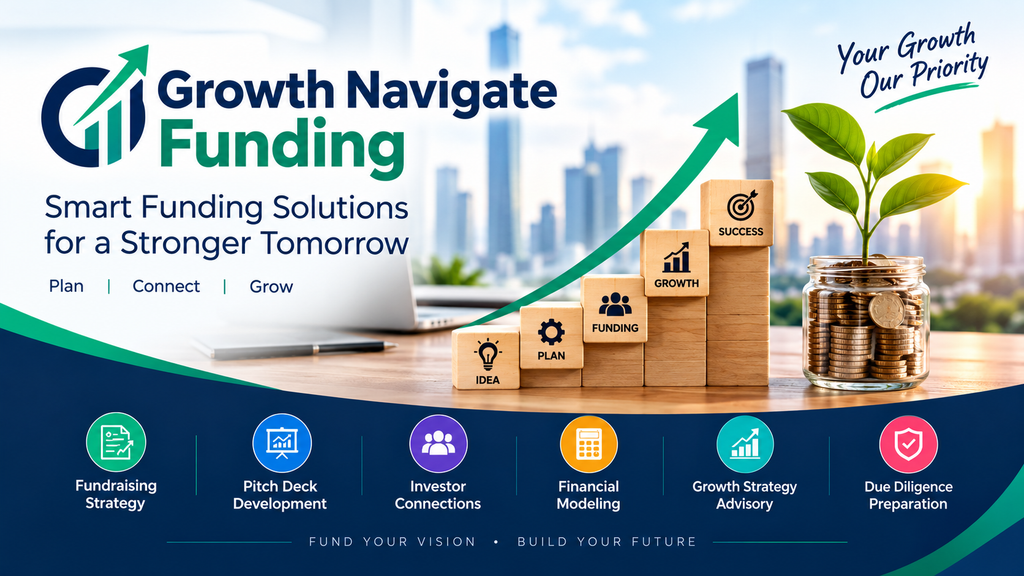
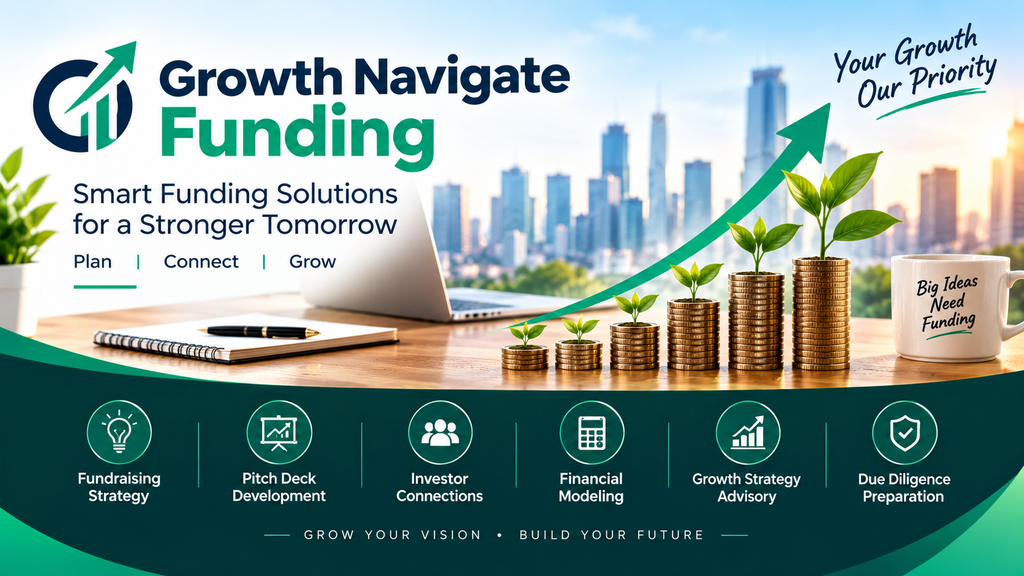
The Growth Navigate Funding website advertises several services intended to help startups prepare for fundraising and manage growth after securing capital.
Growth Navigate Funding
The availability, scope, pricing, and quality of these services should be confirmed directly with the provider before making a commitment.
Fundraising Strategy
Fundraising strategy involves creating a plan for raising capital based on a company’s stage, financial requirements, market opportunity, and growth objectives.
An effective strategy identifies the type of investor or lender to approach, the amount of money required, the milestones that funding should support, and the timeline for the fundraising process.
A pre-seed startup may need funding to develop an initial product, while a more established business may seek investment to expand into new markets.
A well-defined strategy helps founders focus on appropriate funding sources instead of pursuing every available opportunity. growth navigate funding
Pitch Deck Development
A pitch deck is a concise presentation that explains a company’s business model and investment opportunity.
A useful pitch deck typically includes:
- The problem the business solves.
- Its product or service.
- The target market and competitive environment.
- The business model and revenue strategy.
- Customer traction and supporting evidence.
- The founding team and relevant experience.
- Financial projections and major assumptions.
- The funding amount requested and planned use of funds.
- growth navigate funding
- growth navigate funding
- growth navigate funding
- growth navigate funding
- growth navigate funding
- growth navigate funding
- growth navigate funding
- growth navigate funding
- growth navigate funding
Professional presentation matters, but attractive design alone cannot make a weak business opportunity compelling. Investors also evaluate market demand, execution ability, financial assumptions, and the potential return relative to risk.
Investor Relations and Connections
Investor relations involves communicating with current and potential investors, providing accurate business information, and maintaining professional relationships.
An advisory service may help identify potential investors whose interests align with a startup’s sector, development stage, and funding requirements.
However, access to an investor network does not guarantee an introduction, investment offer, or completed funding round. Founders should ask how investor matching works and whether any claimed relationships or introductions can be demonstrated.
Financial Modeling and Forecasting
Financial modeling helps businesses estimate how revenue, expenses, cash flow, and financing decisions may affect future performance.
A financial model may include revenue assumptions, staffing costs, customer acquisition expenses, operating margins, capital requirements, and cash runway.
Scenario analysis is particularly useful. A founder can examine what happens if customer growth is slower than expected, operating costs increase, or a fundraising round takes longer to close.
Realistic financial modeling supports better planning and helps investors understand the assumptions behind a company’s growth projections.
Growth Strategy Advisory
Funding is only one part of business development. Companies must also understand how to convert capital into revenue, improve customer retention, strengthen operations, and maintain profitability.
Growth strategy advisory may cover pricing, market positioning, sales processes, customer acquisition, operational efficiency, and expansion planning.
The goal is to create a business model that can use additional resources productively rather than simply increasing spending.
Due Diligence Preparation
Due diligence is the process through which investors or lenders examine a business before completing a transaction.
A company may need to provide financial statements, ownership information, contracts, intellectual property records, customer information, and evidence supporting its claims.
Preparing these records in advance can reduce delays and help founders respond to investor questions accurately.
Businesses should keep documents organized, protect confidential information, and obtain professional advice when dealing with sensitive legal or financial records.
Who Can Benefit from Growth Navigate Funding?
Funding advisory services can be useful for businesses that need capital, clearer financial planning, or a more organized fundraising process. However, the value of an advisory service depends on the company’s needs and the provider’s actual capabilities.
Early-Stage Startups
Early-stage startups often have a product idea, a small team, and limited operating history. They may need capital to build a prototype, test customer demand, hire specialists, or develop an initial sales channel.
At this stage, founders should be prepared to explain the problem they are solving, identify their target customers, and demonstrate why the proposed product has commercial potential.
Funding advisers may help founders refine their business plans and prepare presentations. Nevertheless, early-stage investment is uncertain, and investors may require evidence of demand before committing capital.
Growing Small Businesses
Established small businesses may need additional working capital to increase inventory, improve equipment, hire staff, or open new locations.
These businesses often have sales records and existing customers, which can help lenders assess repayment capacity. Their funding requirements may be better suited to business loans, lines of credit, equipment financing, or other financing arrangements than to venture capital.
A financial adviser can help compare alternatives, but business owners should calculate the total cost of financing before choosing an option.
Technology and SaaS Companies
Technology startups may require funding for software development, cybersecurity, product testing, customer acquisition, and infrastructure.
Software-as-a-service companies may also need to demonstrate recurring revenue, customer retention, acquisition costs, and the economics of their subscription model.
Investors generally want to understand how a technology company can acquire customers efficiently and grow without allowing costs to increase faster than revenue.
E-Commerce and Consumer Brands
E-commerce businesses may require funding for inventory, warehousing, advertising, logistics, and new product development.
Their financial planning should account for seasonal sales, inventory turnover, supplier payment terms, and customer acquisition costs.
A company that experiences rapid sales growth can still encounter cash-flow problems if it must pay suppliers long before customers or sales platforms release the corresponding revenue.
Established Companies Planning Expansion
Mature businesses may seek capital to enter new geographic markets, acquire another company, launch additional products, or improve operational systems.
These businesses usually need a detailed expansion plan supported by financial projections, market research, and an assessment of potential risks.
Funding should be linked to achievable milestones so management can determine whether expansion is creating value.
Types of Startup Funding to Consider
One of the most important parts of Growth Navigate Funding is understanding that funding is not a single product. Different sources of capital serve different purposes, and each comes with advantages and disadvantages.
Venture Capital Funding
Venture capital is investment provided by specialized firms to businesses with the potential for substantial growth.
In exchange for investment, venture capital firms generally receive an ownership stake and may negotiate governance rights or other contractual protections.
This funding can help startups hire employees, develop products, expand sales, and enter new markets. However, founders may give up some ownership and control.
Venture capital is not appropriate for every business. Investors usually look for opportunities that can grow substantially and potentially deliver a significant return within their investment horizon.
Angel Investor Funding
Angel investors are individuals who invest their own money in early-stage companies. Some also contribute industry knowledge, mentoring, and professional connections.
Angel investment may be suitable for founders who need early capital and can demonstrate a credible business opportunity.
Before accepting an investment, founders should review valuation, ownership dilution, voting rights, investor expectations, and the terms governing future financing rounds.
A supportive investor can add value beyond money, but an unsuitable investor may create disagreements over strategy or control.
Seed Funding
Seed funding helps a startup move from an early concept toward a more developed business.
The capital may support product development, initial hiring, customer research, marketing experiments, or the creation of an early operating model.
Seed financing can come from founders, friends and family, angel investors, seed-stage funds, or other suitable sources.
Founders should define the milestone that seed funding is expected to achieve. This could include launching a minimum viable product, gaining initial customers, or demonstrating that a business model has commercial potential.
Business Loans and Debt Financing
Debt financing allows a business to borrow money that must be repaid according to agreed terms.
Depending on the arrangement, repayment may include interest, fees, collateral requirements, and financial covenants.
Loans allow founders to avoid selling ownership in the company, but repayments can place pressure on cash flow even when revenue falls below expectations.
Businesses should examine the annualized cost of borrowing, repayment schedule, default consequences, personal guarantees, and any early repayment conditions.
Grants and Non-Dilutive Funding
Grants are funds awarded under specific eligibility rules and program conditions. Some government agencies, nonprofit organizations, research institutions, and private foundations provide grants for defined purposes.
Grant funding generally does not require giving up company ownership, although recipients may have reporting duties and restrictions on how money is spent.
Businesses should confirm that a grant program exists, that their organization qualifies, and that the proposed expenses are eligible.
Growth Navigate Funding should not automatically be treated as a government grant or official public funding program. The phrase is associated with commercial advisory services online, and the exact provider and service should be verified before applying or paying.
Growth Navigate Funding
Revenue-Based Financing
Revenue-based financing provides capital that is repaid through an agreed share of future revenue, usually until a specified repayment amount has been reached.
This approach may appeal to companies with established sales that do not want to sell equity.
However, repayment arrangements vary considerably. A business should examine the total repayment obligation, the percentage of revenue allocated to repayment, and the impact on its operating cash flow.
It is particularly important to understand what happens when revenue declines.
Bootstrapping and Reinvested Profits
Bootstrapping means financing business activities through founders’ resources, operating revenue, or retained profits rather than relying primarily on external investors.
This approach allows founders to retain ownership and can encourage disciplined spending.
Its main limitation is that growth may be slower when internal resources are limited. It may also place too much financial pressure on founders if they commit more personal money than they can afford to lose.
For some businesses, a combination of bootstrapping and carefully selected external funding offers a practical balance.
Growth Navigate Funding Process Step by Step
A structured fundraising process helps businesses prepare for investor discussions and evaluate offers more effectively.
Step 1: Define Your Business Goals
Begin by identifying the business problem that additional capital will solve.
A startup may need money to finish product development, while an established company may need additional inventory or working capital. Clearly defining the objective makes it easier to estimate the required amount.
Avoid raising money simply because competitors have raised investment or because funding appears to be a sign of success.
Step 2: Calculate the Funding Gap
Review available cash, expected revenue, planned expenses, existing obligations, and the timing of incoming payments.
The funding gap is the difference between the resources available and the resources needed to achieve the planned objective.
For example, a company may estimate that its next six months of operations will require $120,000. If it expects to generate $45,000 in usable cash during that period and already has $25,000 available, its estimated funding gap would be $50,000.
This simplified calculation must be adjusted for timing, existing debts, unexpected expenses, and a reasonable contingency reserve.
Step 3: Prepare Your Business Documents
Gather the documents that potential investors or lenders may request. Depending on the company and financing type, these can include:
- Business plan and company overview.
- Financial statements and bank records.
- Revenue, expense, and cash-flow forecasts.
- Ownership and incorporation documents.
- Customer contracts and sales information.
- Details of existing loans and investment agreements.
- A pitch deck and use-of-funds breakdown.
Accurate and consistent information builds confidence. Any significant difference between the pitch deck and financial records should be explained before formal discussions begin.
Step 4: Identify Suitable Investors or Lenders
Research potential funding partners according to industry, investment stage, typical investment size, location, and business model.
A venture capital firm that specializes in later-stage technology companies may not be suitable for a small local retailer. Similarly, a lender’s minimum revenue requirements may exclude a startup without operating history.
Targeted research can save time and improve the relevance of outreach.
Step 5: Present the Opportunity Clearly
A strong fundraising presentation should explain what the company does, why customers need it, how it earns revenue, and what additional capital will achieve.
Founders should support their claims with evidence wherever possible. Customer retention, completed sales, signed contracts, pilot results, and credible market research can strengthen a presentation.
Avoid inflated market-size claims, unrealistic forecasts, or statements that imply guaranteed returns.
Step 6: Review Funding Offers
An offer should be evaluated on more than its headline amount.
For equity financing, consider valuation, dilution, investor rights, governance, and future financing implications. For loans, review interest, fees, collateral, guarantees, repayment terms, and default provisions.
Seek qualified legal and financial advice where necessary, particularly when an agreement involves substantial obligations.
Step 7: Close the Transaction and Monitor Progress
Once the necessary checks and negotiations are complete, the parties can finalize the agreement and arrange the transfer of funds.
The business should then track spending against the approved plan and measure progress toward its milestones.
Useful measures may include revenue growth, gross margin, customer retention, operating cash flow, customer acquisition cost, and the amount of time the business can continue operating with its available cash.
Potential Benefits of Growth Navigate Funding
The benefits of a funding advisory approach depend on the business’s starting position and the quality of the support provided. The following are potential benefits, not guaranteed results.
Better Fundraising Preparation
Preparing a pitch deck, financial model, and supporting documents can help founders communicate their opportunity more clearly.
A well-prepared company may also respond more efficiently to investor questions and reduce avoidable delays during due diligence.
More Informed Funding Decisions
Comparing equity, debt, grants, and other funding options helps founders understand the trade-offs associated with each source.
The objective is not simply to raise the largest possible amount. It is to find financing that supports business goals without creating unnecessary financial or operational pressure.
Improved Financial Planning
Financial planning can help companies identify future cash shortages, understand their operating costs, and prepare for different revenue scenarios.
Regular forecasting also helps management decide when to reduce spending, adjust pricing, hire employees, or postpone expansion.
Access to Relevant Networks
Where a provider has genuine, relevant relationships, investor introductions may help founders reach people who understand their industry and funding stage.
However, network size alone is not evidence of investment quality. Founders should ask for details about the introduction process and assess whether potential investors are suitable.
Stronger Post-Funding Management
A business that raises capital still needs to manage that money carefully.
Financial reporting, operational planning, and measurable growth objectives can help management avoid spending too quickly and ensure that investment supports long-term business development.
Growth Navigate Funding Fees and Costs
The cost of using a funding adviser is an important part of the decision. Businesses should understand exactly what they are paying for before entering into an agreement.
Potential fee structures across the funding advisory industry include:
- Fixed fees: A predetermined amount for a specific deliverable, such as reviewing a pitch deck.
- Monthly retainers: Recurring payments for ongoing advisory support.
- Project fees: Charges associated with a defined engagement or milestone.
- Success-based fees: Payments linked to an agreed outcome, where lawful and contractually appropriate.
These are general industry pricing models, not confirmed prices for Growth Navigate Funding.
Before hiring any adviser, request a written fee schedule that explains the services included, additional expenses, payment dates, cancellation terms, and refund conditions.
A low initial price may exclude important work, while a high monthly fee does not guarantee better results. Compare the proposed deliverables with your actual needs.
Also clarify whether the provider is offering advice, preparing documents, making introductions, negotiating transactions, or acting in another capacity. Different activities can carry different legal and regulatory considerations.
Is Growth Navigate Funding Legitimate?
This is an important question for anyone researching Growth Navigate Funding. Before trusting a funding adviser, business owners should distinguish between a website’s own claims and information that can be independently verified.
The website GrowthNavigateFunding.com presents itself as a startup fundraising advisory service and publishes information about its services, investor network, and reported funding results. Those figures are company-reported claims and should not be treated as independently confirmed performance data.
Growth Navigate Funding
The existence of a website does not, by itself, establish the provider’s track record, financial standing, regulatory status, or suitability for a particular business.
Check the Exact Company Website
Several websites use similar Growth Navigate names, including GrowthNavigateFunding.com and GrowthNavigate.com. They describe related business and financial services, but the available information does not establish that they are the same legal entity.
Growth Navigate Funding
Always confirm the exact domain, legal business name, contact details, and contracting entity before sharing sensitive information or signing an agreement.
Verify Company Background and Track Record
Ask for verifiable details about the people providing the service, their relevant experience, and the work they have completed for businesses similar to yours.
Useful checks include:
- Reviewing official business registration records where applicable.
- Requesting references from previous clients.
- Examining independently verifiable case studies.
- Asking how reported funding totals and success rates are calculated.
- Confirming the identity and role of the person handling your engagement.
- Checking any relevant professional registrations or regulatory requirements.
Testimonials published on a provider’s own website can offer context, but they are not equivalent to independent verification.
Understand Funding Guarantees and Risks
A funding adviser cannot control every investor’s decision. Fundraising depends on factors such as business performance, market conditions, investor appetite, valuation, and the proposed terms.
The published terms for GrowthNavigate.com state that specific funding results and financial outcomes are not guaranteed. This is a reminder to read the terms of the exact company you intend to hire rather than assuming similarly named websites have identical conditions.
Growth Navigate
Be cautious of anyone who promises guaranteed investment, pressures you to pay immediately, refuses to explain fees, or asks you to misrepresent your business.
Practical conclusion: The available public information supports describing Growth Navigate Funding as an advertised fundraising advisory service. It is not sufficient, on its own, to establish that every company claim or reported result is independently verified.
Growth Navigate Funding vs. Traditional Business Funding
Growth Navigate Funding, when used to describe advisory support, differs from obtaining financing directly from a bank, investor, or grant provider.
| Feature | Funding advisory service | Direct lender or investor |
| Main role | Helps prepare and organize fundraising | Provides or invests capital if approved |
| Financial planning | May assist with forecasts and funding strategy | May assess financial information |
| Investor connections | May offer introductions | May invest directly or participate in financing |
| Fees | May charge advisory or project fees | May charge interest, fees, or require equity |
| Funding guarantee | Depends on no provider’s promise alone | Approval and terms depend on the provider |
| Main consideration | Service quality and value | Cost, eligibility, risk, and contract terms |
An advisory service may help a company become better prepared, but it does not replace the actual financing decision made by a lender or investor.
Some businesses can approach banks or investors directly. Others may benefit from specialized advice, particularly when preparing for their first institutional fundraising round.
The best option depends on the company’s experience, available resources, funding requirements, and ability to manage the process internally.
Tips for Preparing a Successful Funding Application
Whether you work with an adviser or approach funding providers independently, preparation can improve the quality of your application.
Build a Realistic Business Plan
Explain the product or service, target market, competitive position, revenue model, operating costs, and growth strategy.
Avoid relying entirely on optimistic projections. Investors and lenders need to understand what the company expects to achieve and what could prevent it from doing so.
Demonstrate Customer Demand
Evidence of customer demand can strengthen a funding request. Depending on the business, this may include completed sales, repeat purchases, customer retention, signed contracts, or results from a pilot project.
Early-stage companies without meaningful sales should explain how they tested their assumptions and what they learned.
Explain How the Money Will Be Used
Create a clear breakdown of planned spending. Separate product development, staffing, marketing, inventory, equipment, and working capital where relevant.
Connect these expenses to measurable milestones so potential funders can understand the intended purpose of the capital.
Maintain Accurate Financial Records
Keep financial statements, bank records, tax documents, ownership information, and existing financing agreements organized.
Financial records should be consistent with the figures used in the business plan and pitch deck. If assumptions change, update the relevant documents before sharing them.
Prepare for Difficult Questions
Potential funders may ask about competition, customer acquisition costs, profit margins, debt obligations, cash runway, and the assumptions behind revenue projections.
Prepare clear answers supported by evidence. If an estimate is uncertain, explain the assumptions instead of presenting it as a guaranteed outcome.
Compare Multiple Funding Options
Do not assume that the first offer is the best one. Compare several suitable providers or financing structures where possible.
Consider the total cost, speed, eligibility requirements, ownership implications, repayment obligations, and the flexibility offered by each option.
How AEO and GEO Improve Growth Navigate Funding Content
AEO stands for Answer Engine Optimization, while GEO stands for Generative Engine Optimization. Both approaches aim to make information clearer and easier for search systems and AI-powered tools to understand and summarize.
For an article targeting Growth Navigate Funding, these approaches work best when the content directly answers relevant questions and separates verified facts from assumptions.
AEO: Answer Questions Directly
AEO-friendly content provides concise answers near the beginning of relevant sections.
For example:
What is Growth Navigate Funding?
Growth Navigate Funding is a phrase associated with startup fundraising advisory services and the broader process of obtaining capital for business growth. The specific services and company details depend on the provider being discussed.
This type of direct answer helps readers understand the topic without searching through several paragraphs.
GEO: Provide Clear, Trustworthy Context
GEO focuses on making content useful to AI-driven search and answer systems.
For this topic, useful practices include:
- Using descriptive headings that accurately reflect each section.
- Explaining financial terms in plain English.
- Identifying the source of company-specific claims.
- Including practical examples of funding decisions.
- Distinguishing general industry practices from advertised services.
- Answering related questions consistently throughout the article.
- Updating information when reliable new evidence becomes available.
No optimization method guarantees that an article will appear in an AI-generated answer. The goal is to make the content accurate, well structured, and genuinely useful.
Recommended Structured Data
For a published article, relevant structured data may include Article or BlogPosting. An FAQ section can also be written in a clear question-and-answer format.
Structured data should accurately reflect visible page content. Adding markup does not guarantee enhanced search results, and FAQ rich-result eligibility is restricted by Google’s current policies.
Frequently Asked Questions About Growth Navigate Funding
What Is Growth Navigate Funding?
Growth Navigate Funding is a term associated with a startup fundraising advisory service and the process of finding suitable capital for business development. The specific company and its services should be confirmed using the exact website and contractual information.
What Services Does Growth Navigate Funding Advertise?
The GrowthNavigateFunding.com website advertises fundraising strategy, pitch deck development, investor relations, financial modeling, growth strategy advisory, and due diligence preparation. These descriptions reflect the provider’s published service information.
Growth Navigate Funding
Does Growth Navigate Funding Provide Money Directly?
The advertised services focus on fundraising advisory and related support. Businesses should confirm whether a particular engagement includes direct lending, investment, or introductions to external financing providers.
Is Growth Navigate Funding a Government Grant?
It should not automatically be considered a government grant. The website reviewed presents it as a commercial fundraising advisory service rather than a verified government funding scheme. Always check the official source of any grant opportunity.
Who Can Benefit from Funding Advisory Services?
Startups, small businesses, technology companies, and established businesses planning expansion may benefit from fundraising advice when they need help with financial planning, investor presentations, or capital strategy.
The usefulness of a service depends on its quality, the company’s requirements, and the cost involved.
How Much Does Growth Navigate Funding Cost?
A verified, comprehensive fee schedule was not established by the sources reviewed for this article. Contact the exact provider for current pricing and request written details about retainers, project fees, additional charges, and cancellation conditions.
Does Growth Navigate Funding Guarantee Investment Approval?
No business should assume that an adviser can guarantee an investment decision. Investors and lenders make their own assessments, and funding depends on the opportunity, eligibility, risk, and agreed terms.
What Documents Are Needed for Business Funding?
Common documents include a business plan, financial statements, cash-flow projections, ownership records, bank statements, and a description of how the capital will be used. Exact requirements depend on the financing source.
How Can I Check Whether a Funding Adviser Is Trustworthy?
Verify the legal company name, relevant registrations, professional background, independent references, written fee schedule, and contractual terms. Be cautious of guaranteed results, pressure to pay immediately, and requests for unnecessary sensitive information.
What Are the Best Alternatives to Funding Advisory Services?
Businesses may approach banks, qualified investors, suitable grant programs, angel investors, or other financing providers directly. Bootstrapping and reinvesting profits may also be appropriate, depending on the business model and growth goals.
Final Thoughts on Growth Navigate Funding
Growth Navigate Funding is a useful topic for entrepreneurs researching fundraising strategy, business financing, investor connections, and sustainable company growth. Understanding these areas helps business owners make informed decisions about when to raise capital, which financing options to consider, and how to use funds responsibly.
The advertised Growth Navigate Funding service focuses on fundraising preparation and related advisory activities. However, founders should independently verify company-specific claims, confirm the exact legal entity, and review fees and contractual terms before engaging any provider.
A successful funding strategy begins with a clear business objective, realistic financial projections, reliable records, and an appropriate choice of financing. Whether a company needs seed funding, venture capital, a business loan, or another source of capital, careful preparation and responsible financial management remain essential.
Ultimately, the purpose of growth-focused funding is not simply to obtain money. It is to secure the right resources, under suitable terms, to build a stronger and more sustainable business.