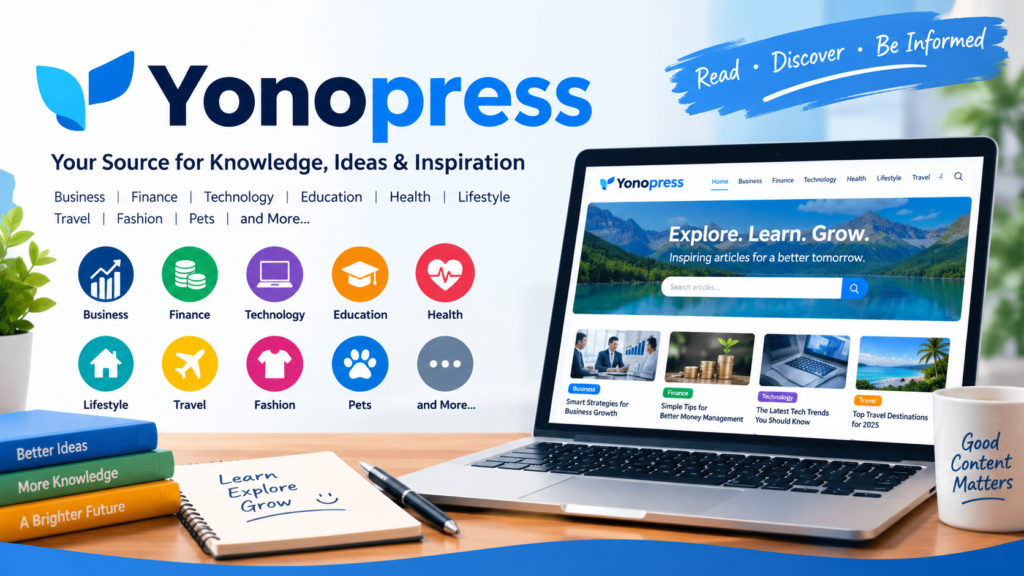

Introduction to Yonopress
The internet has become one of the most important sources of information for people who want to learn new skills, understand technology, explore business opportunities, and stay informed about different subjects. Every day, millions of readers search for websites that provide clear explanations, practical advice, educational resources, and useful articles. Yonopress is one of the online publication names that readers may encounter while searching for information across different topics.
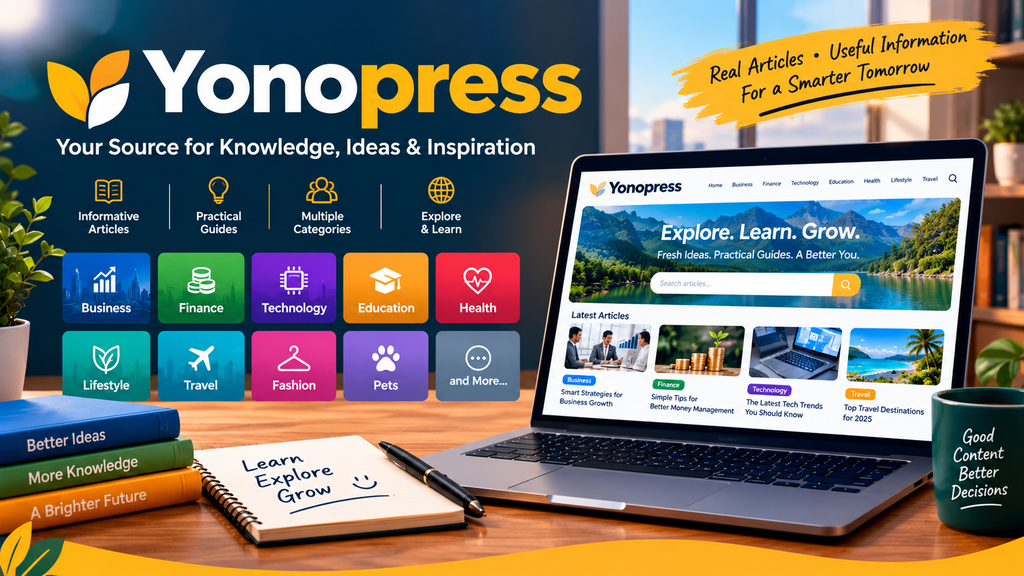
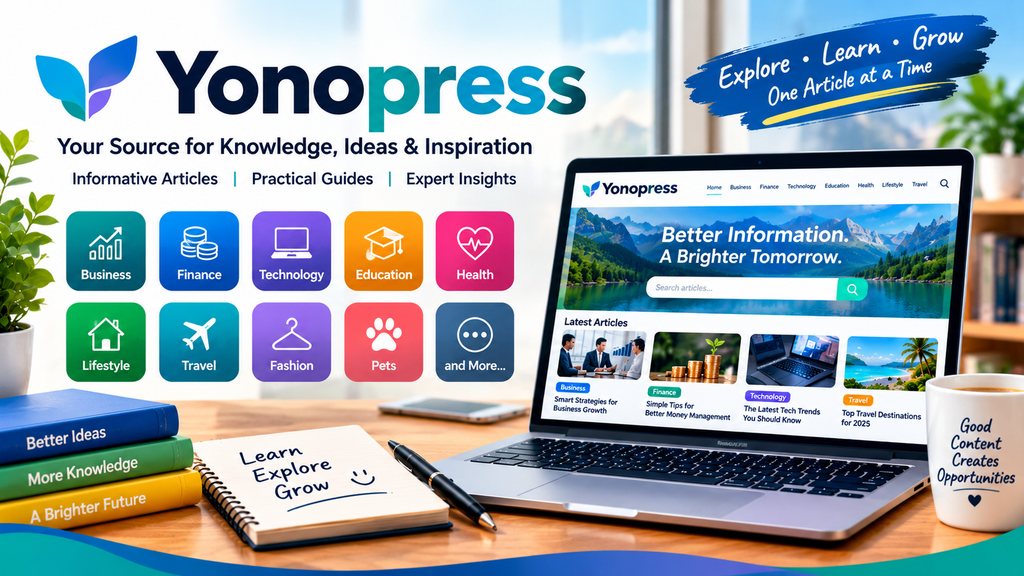
Yonopress.com presents itself as a multi-topic digital publication covering subjects such as business, finance, technology, education, health, lifestyle, travel, fashion, and pets. The website brings different categories of information together so that readers can explore multiple interests in one place. Its content includes informational articles, practical guides, educational resources, and discussions about topics that matter in everyday life.
Understanding Yonopress requires more than simply knowing its name. Readers may want to learn what the website publishes, how its content is organized, who can benefit from it, and how to evaluate the information they find there. These questions are especially important when people use online articles to research unfamiliar subjects or make decisions.
This comprehensive guide explains Yonopress, its stated purpose, its content categories, its potential benefits, and the factors readers should consider when evaluating its articles. It also explores how to navigate a multi-topic publication, verify information, and use online resources responsibly.
Whether you discovered Yonopress through a search engine or encountered its name while researching a particular topic, this guide will help you understand its general role in the digital publishing landscape.
What Is Yonopress?
Yonopress is an online publishing name associated with websites that provide informational content across a range of subjects. Yonopress.com describes itself as a digital media publication designed to make useful information easier to discover, understand, and apply.
Rather than focusing exclusively on one industry, Yonopress.com publishes content across several categories. These include business, education, finance, health, lifestyle, technology, travel, and other areas of general interest. This broad approach allows readers with different interests to explore articles without limiting themselves to a single subject.
In simple terms, Yonopress.com can be understood as a multi-niche content website where visitors can discover articles, explanations, and practical guides.
The name Yonopress is also used by yonopress.io, which presents a different focus centered on search engine optimization tools, artificial intelligence tools, software reviews, and digital marketing resources. Readers should distinguish between these domains because their stated content offerings are not identical.
For anyone researching Yonopress, the first step is to identify the exact website they intend to visit. A domain name matters because similarly named websites do not necessarily share the same ownership, services, editorial policies, or business operations.
The Main Purpose of Yonopress
The primary purpose described by Yonopress.com is to make information accessible and understandable for a broad audience. The website aims to cover subjects that readers may encounter in their professional lives, studies, personal interests, and everyday activities.
Online information is widely available, but finding a useful explanation can sometimes be difficult. Some articles are too technical, others lack sufficient context, and some provide information that is difficult to verify. A publication that organizes content into recognizable categories can help readers discover material relevant to their questions.
Yonopress.com aims to address this need by publishing articles intended to explain topics in a straightforward and practical way.
Its general purpose can be understood through several objectives:
- Providing information across multiple subject areas.
- Helping readers explore unfamiliar topics.
- Presenting explanations in an accessible format.
- Publishing practical guides for everyday questions.
- Offering educational material for curious readers.
- Making different categories of content available through one website.
These objectives describe the publication’s stated approach rather than guaranteeing that every article meets the same standard of quality. Readers should still evaluate individual articles based on their accuracy, relevance, evidence, and usefulness.
How Does Yonopress Work?
Yonopress.com functions as an online publication. Readers visit the website, browse available categories, open articles, and explore information related to their interests.
The general process is similar to using other content websites.
First, a visitor identifies a topic they want to understand. This might involve technology, financial concepts, education, travel planning, lifestyle advice, or a business-related question.
Next, the visitor explores the website’s available articles. Depending on the website’s current structure, they may browse category pages, use internal navigation, or locate a particular article through a search engine.
After opening an article, the reader can review its headings, explanations, examples, and recommendations. A well-organized article should make its central subject clear and help readers understand the information without unnecessary confusion.
Finally, the reader decides whether the information answers their question. If the topic involves health, money, legal matters, or another important decision, the reader should consult appropriate primary sources or qualified professionals before acting on the information.
Yonopress is best approached as a source for discovering and exploring information, not as an automatic substitute for independent research.
Key Features of Yonopress
The features of an online publication are not limited to technical functions. Its subject coverage, article organization, accessibility, and editorial approach also influence the reader’s experience.
1. Multiple Content Categories
One of the main characteristics of Yonopress.com is its broad subject coverage. Readers can explore different areas of interest without needing to visit a separate specialist publication for every general question.
For example, someone researching a business topic may also be interested in technology or personal finance. A student may want educational resources and information about digital tools. A traveler may look for destination information alongside lifestyle articles.
A multi-category structure makes these different interests easier to explore.
2. Informational Articles
Informational content helps readers understand a subject, learn a definition, or find answers to specific questions.
Such articles can introduce unfamiliar concepts, explain terminology, outline important considerations, and provide background information. Their usefulness depends on how clearly the subject is explained and whether the information is accurate.
Readers should look for articles that address the main question directly rather than relying on vague introductions or repetitive statements.
3. Practical Guides
Practical guides are designed to help readers understand a process or approach a task.
Depending on the subject, a guide may explain how something works, identify the steps involved, describe common mistakes, or outline factors that should be considered before making a decision.
Practical content is particularly useful when it includes realistic examples and explains the limitations of its recommendations.
4. Accessible Presentation
Clear writing can make complicated topics easier to understand. Short paragraphs, descriptive headings, meaningful examples, and straightforward explanations help readers find the information they need.
Yonopress.com states that it aims to publish content that is clear, organized, informative, and easy to understand. Readers can assess whether an individual article achieves these objectives by reviewing its structure and substance.
5. Broad Audience Appeal
A multi-topic publication can appeal to students, professionals, entrepreneurs, travelers, technology enthusiasts, and general readers.
However, the usefulness of the website depends on the subject being researched. A broad informational article may be sufficient for learning the basics, while a specialized question may require a more authoritative or technical source.
6. Online Accessibility
A website makes it possible for readers to explore published material through an internet-connected device. Visitors can generally access online articles through a desktop computer, laptop, tablet, or smartphone, subject to the website’s current technical requirements and availability.
Accessibility should not be confused with a guarantee that every page will always be available or that every feature will work on every device.
Exploring the Main Content Categories on Yonopress
The different content categories are central to understanding Yonopress.com. Each category addresses a different set of interests and questions.
Business and Entrepreneurship
Business content can help readers understand how organizations operate, how entrepreneurs approach challenges, and how companies respond to changing markets.
Articles in this category may explore business strategies, workplace practices, entrepreneurship, productivity, management, and industry developments.
A beginner researching entrepreneurship, for example, might want to understand how business planning works, why customer research matters, or which factors influence a company’s growth.
Business articles can provide useful introductory knowledge, but readers should distinguish general advice from recommendations tailored to a specific company or market.
Business decisions often depend on location, industry, available resources, regulations, and financial circumstances. More specialized questions require evidence from relevant industry sources and professionals.
Finance and Money Management
Finance is another important area for readers seeking to understand money-related concepts.
Financial information can cover budgeting, saving, investment terminology, market developments, financial planning, and personal money management. Such topics may help readers become more familiar with financial concepts and recognize questions they need to investigate further.
For example, a beginner might use an introductory article to learn the difference between saving and investing. Another reader may want to understand how interest rates affect borrowing costs.
However, financial information must be evaluated carefully. An article that explains an investment concept does not automatically provide suitable investment advice for every reader.
Before making financial decisions, readers should consider their circumstances, verify figures using current primary sources, and consult qualified professionals when necessary.
Technology and Digital Trends
Technology changes rapidly, influencing communication, education, business, entertainment, and everyday activities.
Technology-related articles can help readers understand digital services, software, applications, gadgets, online platforms, and emerging developments.
A reader might explore an article to learn what a particular technology does, how a digital service works, or which considerations matter when selecting software.
Useful technology content should explain unfamiliar terms, provide sufficient context, and identify limitations where relevant.
Because software features and digital services can change, readers should verify current specifications, pricing, compatibility, and security requirements through official product documentation.
Education and Learning
Educational content supports people who want to develop their knowledge or understand a subject more clearly.
Students may use general articles to review concepts, explore topics outside their coursework, or identify areas that need further study. Lifelong learners may use educational resources to discover new interests and develop practical knowledge.
Good educational writing explains ideas logically, introduces terminology carefully, and uses examples to clarify difficult concepts.
However, general online articles should complement rather than replace official course materials, academic references, textbooks, and instructions from qualified educators.
Readers working on formal assignments should verify facts and follow their institution’s rules for citations and original work.
Health and Wellness
Health content can introduce readers to general topics related to physical well-being, nutrition, fitness, sleep, and healthy habits.
Such information may help readers become familiar with common health concepts and prepare better questions for a healthcare professional.
Nevertheless, health is a sensitive subject because individual needs vary significantly. An article intended for general education cannot determine a person’s diagnosis, recommend treatment for every situation, or replace a medical assessment.
Readers should prioritize recognized medical organizations, current clinical guidance, and qualified healthcare professionals when researching symptoms, medications, treatment options, or persistent health concerns.
Yonopress.com describes its health-related material as informational and educational rather than a substitute for professional medical advice.
Lifestyle and Everyday Living
Lifestyle articles cover subjects that influence daily routines, personal interests, relationships, home activities, and individual well-being.
Readers may explore practical ideas for organizing their time, improving everyday habits, managing household tasks, or understanding common lifestyle choices.
The usefulness of lifestyle content often depends on whether the advice is realistic and adaptable to different circumstances.
A suggestion that works well for one person may not suit another person’s budget, schedule, location, or preferences. Readers should treat general recommendations as starting points rather than universal rules.
Travel and Destination Information
Travel content can help readers discover destinations, learn about local attractions, explore trip-planning ideas, and understand common travel considerations.
A general travel guide might introduce a destination’s geography, cultural attractions, transport options, or seasonal characteristics.
Travel information is most useful when it distinguishes general background from details that can change quickly.
Visa rules, entry requirements, transportation schedules, accommodation prices, weather conditions, and safety advisories should be checked using current official sources before a trip.
Readers should also consider personal accessibility needs, travel budgets, and local regulations when planning an itinerary.
Fashion and Personal Style
Fashion-related articles can explore clothing trends, styling ideas, wardrobe planning, seasonal choices, and personal presentation.
Readers may use these resources to discover different styles, understand clothing combinations, or find inspiration for everyday outfits.
Fashion is subjective, so readers should consider their individual preferences, comfort, budget, and circumstances rather than treating every trend as a requirement.
When an article discusses a specific product, readers should verify its current availability, sizing, material details, and price directly with the relevant seller or manufacturer.
Pets and Animal Care
Pet-related content can introduce readers to animal behavior, routine care, responsible ownership, and general pet-welfare considerations.
Such articles may help new pet owners identify common questions about feeding routines, exercise, grooming, and creating a suitable living environment.
However, an informational article cannot replace veterinary advice. Symptoms, injuries, sudden behavioral changes, and questions about medication should be discussed with a qualified veterinarian.
Reliable pet-care information should recognize that different species, breeds, ages, and individual animals may have different needs.
Who Can Benefit from Yonopress?
The potential audience for Yonopress.com is broad because its content spans multiple categories.
Students and Lifelong Learners
Students can use general articles to introduce themselves to unfamiliar topics, review basic concepts, and discover additional research questions.
For example, a student learning about digital technology might begin with an introductory explanation before moving on to technical documentation or academic research.
The website may also be useful to people who enjoy learning outside a formal educational setting.
Professionals and Business Owners
Professionals often need to understand new concepts, explore industry developments, or identify areas for further research.
A multi-topic publication can help them discover general background information on subjects related to business, finance, technology, and workplace practices.
Business owners may use introductory guides to understand unfamiliar terminology or explore potential approaches to a challenge. More important decisions should be supported by specialist advice and reliable evidence.
Technology Enthusiasts
Readers interested in technology can explore digital trends, applications, online services, and emerging tools.
This material may help them identify products or subjects worth researching in greater detail.
Before downloading software, sharing personal information, or purchasing a digital service, users should investigate the product’s official documentation, security practices, and terms.
General Readers
Not every online search has a professional purpose. Some readers simply want to learn something new, explore a hobby, or understand a subject they recently encountered.
A multi-niche publication can serve as a starting point for this kind of informal learning.
Its broad scope allows readers to move between different subjects according to their interests.
How to Navigate Yonopress Effectively
Finding useful information is easier when readers approach a website with a clear objective.
Step 1: Identify Your Question
Before browsing, determine what you want to learn.
Instead of searching for a broad subject such as technology, consider a more specific question, such as how a particular type of software works or what factors matter when choosing a digital service.
A focused question makes it easier to identify relevant content.
Step 2: Choose the Relevant Category
Explore the category most closely related to your question.
Business, finance, education, health, technology, travel, lifestyle, and other categories provide different starting points. Selecting the right category can reduce the amount of unrelated material you need to review.
Step 3: Review the Article Heading and Introduction
Read the title and opening paragraphs to determine whether the article addresses your question.
A useful introduction should identify the topic and establish what the reader can expect to learn.
If an article appears unrelated to your needs, consider another source rather than reading it simply because it appeared in your search results.
Step 4: Use Headings to Find Important Information
Descriptive headings make longer articles easier to navigate.
Review the main sections to locate definitions, explanations, examples, advantages, limitations, or other relevant details.
This approach can save time while helping you understand how the article is organized.
Step 5: Check Dates and Supporting Evidence
Some information remains useful for years, while other details become outdated quickly.
Check publication or update dates when they are available. For current prices, regulations, product features, and market information, look for evidence from official sources.
A recent publication date is helpful, but it does not independently prove that an article is accurate.
Step 6: Compare Important Claims
If the information could influence an important decision, compare it with additional sources.
For example, financial claims should be checked against relevant financial institutions or official market information. Medical claims should be compared with recognized healthcare guidance.
Independent verification helps readers avoid relying too heavily on a single article.
Is Yonopress Free to Use?
The public-facing Yonopress.com publication presents articles that visitors can explore online. The availability of individual pages and features may depend on the website’s current setup.
Readers should check the particular domain they are visiting before assuming that every service is free.
This distinction is especially relevant because Yonopress is a name used by more than one website. A content publication may offer publicly accessible articles, while another website using a similar name may provide different products or services.
Before creating an account, submitting personal information, or paying for a service, review the website’s official pricing details and terms.
For readers who simply want to explore publicly available articles, the first step is to visit the intended website and check whether the relevant content can be accessed directly.
What Makes a Useful Online Article?
A website’s value depends heavily on the quality of the information it publishes.
Readers should evaluate articles using several practical criteria.
Accuracy
Accurate content explains facts correctly and avoids unsupported statements.
Articles discussing technical, scientific, financial, or medical subjects should be especially careful about terminology, figures, and conclusions.
When possible, verify important claims against primary sources.
Clarity
A useful article makes its main point easy to understand.
It explains necessary terminology, avoids unnecessary repetition, and presents ideas in a logical sequence.
Clear writing does not mean oversimplifying a complicated subject. It means providing enough context for the intended audience to understand the essential information.
Relevance
An article should address the question that brought the reader to the page.
Content that spends too much time on unrelated background can make it harder to find the answer.
Relevant headings, examples, and summaries help readers determine which information matters most.
Evidence
Strong informational writing distinguishes established facts from opinions, interpretations, and predictions.
Supporting references allow readers to investigate claims and understand where the information originated.
Readers should be cautious when an article makes significant claims without explaining the evidence behind them.
Transparency
Trustworthy publishing practices make it easier to understand who is responsible for the content and how readers can report errors.
Author information, contact details, editorial policies, corrections, and disclosures can all help readers evaluate a publication.
No single transparency feature proves that a website is reliable, but the overall presentation can provide useful clues.
Is Yonopress Legit and Trustworthy?
The question of legitimacy should be approached carefully. A website’s existence and published content do not automatically establish the accuracy of every article or the reliability of every service associated with its name.
Yonopress.com describes itself as a digital publication that provides informational content across multiple subjects. This description helps explain the website’s stated purpose, but it is not independent proof that every published claim has been verified.
Readers should assess Yonopress using the same standards they would apply to any online information source.
Start by confirming the domain name. Make sure the website you are visiting is the intended one, particularly when multiple domains use similar branding.
Next, review the article itself. Look for a clear author or editorial attribution where available, relevant publication dates, supporting evidence, and explanations that can be checked against independent sources.
Consider whether the article distinguishes facts from opinion. Be cautious about extraordinary promises, guaranteed results, exaggerated claims, or recommendations that create pressure to act immediately.
For transactions or account-related services, review the site’s contact information, privacy policy, terms of use, and payment arrangements before sharing sensitive information.
A website should not be considered trustworthy solely because it looks professional or appears prominently in search results.
The most reasonable approach is to use Yonopress as a possible starting point for research and verify important claims before relying on them.
Yonopress.com vs. Yonopress.io: Understanding the Difference
One of the most important points when researching Yonopress is that the name is associated with different domains.
Yonopress.com describes a general-interest digital publication covering areas such as education, business, finance, health, lifestyle, technology, and travel.
Yonopress.io presents itself as a platform focused on SEO and artificial intelligence tools, software reviews, pricing comparisons, and digital marketing resources.
Although the names are similar, their stated content focuses differ.
Readers should not assume that the two websites have identical ownership, editorial teams, account systems, services, or policies without reliable evidence establishing those connections.
This distinction matters because a search for Yonopress may return pages from either domain. Someone looking for general lifestyle information may have a different purpose from a marketer researching SEO software.
Before reading an article or using a service, examine the full domain name in the browser’s address bar.
If a website asks for payment, account credentials, or personal information, confirm that you are dealing with the intended service and understand its terms.
Recognizing the correct domain is a simple but important part of researching the Yonopress name accurately.
Benefits of Using a Multi-Niche Publication Like Yonopress
A multi-topic publication can provide several practical advantages when used appropriately.
Convenient Topic Discovery
Readers can explore different subjects within a single publication instead of beginning every search from scratch.
This is helpful when someone wants a general introduction to an unfamiliar topic or wants to discover related areas of interest.
Support for Everyday Learning
Informational articles can help readers build background knowledge and understand basic terminology.
This initial understanding may make more detailed research easier.
Exposure to Different Perspectives
Exploring different categories can introduce readers to ideas they might not have encountered otherwise.
For example, a reader interested in business may discover a technology topic that is relevant to their work.
A Starting Point for Further Research
An introductory article can help identify the next questions to investigate.
Readers may discover unfamiliar terms, relevant organizations, or specific issues that deserve closer examination.
The greatest value often comes from using general information to guide deeper research rather than treating it as the final word.
Flexible Reading Experience
Readers can select content according to their interests and available time.
Some may prefer a short explanation, while others may explore a longer guide covering multiple aspects of a subject.
The usefulness of this flexibility depends on the quality and organization of the available content.
Limitations to Consider When Using Yonopress
Every informational website has limitations, and readers should understand them before relying on published material.
Broad Coverage May Not Provide Specialist Depth
A multi-niche publication covers many subjects, which can be convenient but may not provide the technical depth required for specialized questions.
Readers researching advanced medical issues, legal requirements, engineering problems, or complex financial matters may need specialist publications and professional guidance.
Information Can Become Outdated
Online content does not remain accurate automatically.
Technology changes, financial conditions evolve, regulations are revised, and travel requirements can be updated.
Readers should verify time-sensitive information through current official sources.
Article Quality May Vary
Different topics require different types of expertise and evidence.
Readers should assess each article individually rather than assuming that every page on a website has the same accuracy or depth.
General Advice May Not Suit Every Reader
Recommendations often depend on circumstances that a general article cannot fully account for.
Budget, location, experience, age, professional requirements, and personal priorities can all influence whether a recommendation is appropriate.
Search Visibility Is Not Proof of Accuracy
An article may appear in search results because it is relevant to a query, but its ranking does not independently establish that its claims are correct.
Readers should look beyond search position and examine the evidence.
How Yonopress Fits Into the Digital Publishing Landscape
Digital publishing allows organizations and individuals to distribute information through websites, blogs, online magazines, and specialist resource platforms.
Unlike traditional print publishing, online publications can organize large collections of articles, update pages, and make content discoverable through search engines.
Different publications adopt different approaches. Some focus on breaking news, some concentrate on one professional field, and others publish general-interest material across multiple categories.
Yonopress.com fits the broad, multi-topic publication model described on its website.
Its range of subjects can support readers who want to explore different interests. However, the same breadth means that the most appropriate source will depend on the specific question being researched.
For example, an introductory technology article may help a beginner understand a concept, while a developer will probably need technical documentation. A general finance article may explain a term, while a person making an investment decision will need current data and information suited to their circumstances.
Understanding the role of a publication helps readers choose the right source for each task.
How to Use Yonopress for Better Research
Readers can make online research more effective by following a consistent process.
Begin with a clear question. Identify the information you need rather than browsing without a purpose.
Read for understanding. Review the article’s central explanation and identify any unfamiliar terms.
Record important claims. Note the figures, dates, definitions, or recommendations that matter to your question.
Check the evidence. Follow references when available and compare important information with independent sources.
Separate facts from opinions. Recognize when an article is explaining an established fact and when it is offering an interpretation or recommendation.
Verify current details. Check official sources for changing information such as prices, product features, regulations, and schedules.
Make decisions carefully. For health, financial, legal, or safety-related matters, seek appropriate professional guidance when needed.
This process applies not only to Yonopress but also to blogs, digital magazines, specialist websites, and other online publications.
Yonopress and Search Engine Optimization
Search engine optimization, commonly known as SEO, is the process of improving a website’s ability to appear in relevant search results.
Although Yonopress.com is a general-interest publication, its articles may be discovered through search engines when they match a reader’s query.
For publishers, useful content begins with understanding what readers want to know. A page should address the subject clearly, use descriptive headings, and organize information in a way that helps visitors find answers.
Natural keyword placement can clarify a page’s subject. However, repeating the same keyword excessively can make an article less readable and does not guarantee better rankings.
Search engines can also consider many other factors, including technical accessibility, page experience, relevance, and the quality of the overall content.
For readers researching Yonopress, SEO is mainly relevant because it explains one way online articles become discoverable. Search visibility alone should never be treated as a substitute for evaluating accuracy or credibility.
Yonopress and Answer Engine Optimization (AEO)
Answer Engine Optimization, or AEO, is a content approach that makes answers easier for readers and answer-focused search experiences to identify.
AEO-friendly content places clear answers near the questions they address. It uses descriptive headings, concise definitions, relevant examples, and organized supporting information.
For example, a reader searching for “What is Yonopress?” should find a direct explanation near the beginning of the article rather than having to read several unrelated paragraphs first.
Frequently asked questions can also help address specific user needs.
However, including AEO elements does not guarantee that a page will appear in a featured snippet, AI-generated answer, or other prominent search result. These placements depend on search systems and many factors beyond the article’s formatting.
A practical AEO approach for a Yonopress article includes:
- Answering the main question in the introduction.
- Using question-based headings where appropriate.
- Providing concise and accurate explanations.
- Supporting important claims with credible evidence.
- Including relevant FAQs.
- Avoiding exaggerated claims and unnecessary repetition.
The objective is to make the information genuinely useful, not simply to format content for search engines.
Yonopress and Generative Engine Optimization (GEO)
Generative Engine Optimization, or GEO, refers to approaches intended to improve how content can be understood and potentially referenced by generative AI search and answer systems.
These systems may synthesize information from multiple sources to respond to user questions. Content that is clear, well-structured, specific, and supported by credible evidence can be easier to interpret.
For a topic such as Yonopress, a GEO-friendly article should clearly identify the publication, explain the distinction between similarly named domains, describe the relevant content categories, and avoid unsupported assumptions about ownership or services.
Clear entity references are particularly important. If an article discusses Yonopress.com, it should not casually attribute the features of Yonopress.io to the .com website.
GEO-oriented content should also distinguish between a website’s own claims and independently verified information.
Useful practices include writing precise definitions, using descriptive headings, explaining relevant relationships, maintaining factual consistency, and citing reliable sources when appropriate.
There is no guaranteed formula for inclusion in AI-generated answers. GEO is best treated as an extension of good content practices rather than a shortcut to visibility.
The Importance of Responsible Content Consumption
Access to online information brings opportunities as well as responsibilities.
Readers should consider how an article was produced, whether its claims are supported, and whether the information is appropriate for their intended use.
When an article discusses a product or service, verify the details with the provider. When it makes a financial claim, investigate the underlying figures. When it offers health information, consult recognized medical resources and qualified professionals.
Readers should also protect their privacy when browsing websites. Avoid sharing unnecessary personal details, review privacy policies where relevant, and be cautious when a page requests sensitive information without a clear reason.
Responsible content consumption means remaining curious while recognizing the limitations of online material.
A useful publication can support learning, but informed decisions require judgment, verification, and awareness of context.
Future of Multi-Topic Digital Publications
Digital publications continue to operate in an environment shaped by changing reader expectations, search technologies, mobile browsing, and artificial intelligence.
Readers increasingly expect online content to answer questions directly, explain complex ideas clearly, and provide practical value without wasting time.
At the same time, the large amount of available information makes accuracy and transparency especially important.
Multi-topic publications can respond to these expectations by improving article organization, keeping information current, making sources easier to identify, and presenting complex subjects in accessible language.
Artificial intelligence may also influence how readers discover and summarize information. However, the presence of AI-related technology does not remove the need for editorial judgment, factual verification, or accountability.
For publications such as Yonopress.com, continued usefulness will depend on whether individual articles meet readers’ needs and provide dependable information.
Ultimately, readers benefit most when digital publications prioritize substance over unnecessary complexity and clarity over exaggerated promises.
Frequently Asked Questions About Yonopress
1. What is Yonopress?
Yonopress is a name associated with online publishing websites. Yonopress.com presents itself as a multi-topic digital publication covering business, finance, technology, education, health, lifestyle, travel, and other subjects.
2. What is Yonopress.com used for?
Yonopress.com is used to explore informational articles and general-interest content. Readers can investigate subjects across its published categories and use relevant articles as starting points for further research.
3. Is Yonopress a website or an online tool?
Yonopress.com is a content publication rather than simply a single-purpose online tool. Yonopress.io, which uses a similar name, focuses on SEO and AI tools, reviews, and digital marketing resources.
4. Is Yonopress free to use?
Readers should check the specific domain and the current terms of the service they intend to use. Publicly accessible articles may be available without payment, but this should not be assumed to apply to every similarly named website or service.
5. What topics does Yonopress cover?
Yonopress.com describes its content as spanning business, education, finance, health, lifestyle, technology, travel, fashion, pets, and other general-interest subjects.
6. Who can benefit from Yonopress?
Students, professionals, business owners, technology enthusiasts, travelers, and general readers may benefit from exploring relevant articles. The value of each article depends on its accuracy, depth, and relevance to the reader’s question.
7. Is Yonopress legitimate?
Yonopress.com presents itself as an online publication, but that description alone does not establish the reliability of every article. Readers should confirm the domain, examine supporting evidence, and verify important claims independently.
8. Is Yonopress.com the same as Yonopress.io?
The two domains have different stated editorial focuses. Yonopress.com covers general-interest topics, while Yonopress.io focuses on SEO and AI tools, reviews, and digital marketing resources. Their similar names do not by themselves establish that they are the same organization.
9. Can Yonopress be used for research?
Yonopress articles can serve as a starting point for general research. For academic, professional, medical, legal, or financial questions, readers should consult primary sources and appropriate specialist references before relying on a claim.
10. Does Yonopress provide health and financial advice?
Yonopress.com includes health- and finance-related informational content. Such articles should not be treated as personalized professional advice. Readers should consult qualified medical or financial professionals for decisions involving their individual circumstances.
11. How can readers evaluate Yonopress articles?
Readers can review the article’s author information, publication date, evidence, references, clarity, and consistency with other credible sources. Important claims should be verified before being used to make decisions.
12. Does Yonopress guarantee accurate information?
No publication should be assumed to guarantee the accuracy of every statement simply because it publishes informational content. Readers should assess individual claims and verify consequential information using appropriate sources.
13. Can Yonopress help readers learn about technology?
Yonopress.com includes technology among its content categories. Readers can explore relevant articles for general explanations, then consult official documentation or specialist resources for advanced or time-sensitive details.
14. Why should readers check the domain name?
Multiple websites can use similar names while offering different content or services. Confirming the domain helps readers locate the intended publication and avoid confusing one website’s features or policies with another’s.
15. What is the best way to use Yonopress?
The best approach is to identify a specific question, explore the relevant article, evaluate its evidence, and verify important claims through credible sources. This allows readers to use online content productively without relying on a single publication for every answer.
Final Thoughts on Yonopress
Yonopress is a useful keyword to understand within the broader context of online publishing. Yonopress.com presents itself as a multi-topic digital publication offering articles across areas such as business, finance, education, health, technology, travel, and lifestyle. Its broad subject coverage may help readers discover information and explore new interests.
The name also appears on Yonopress.io, a website with a stated focus on SEO and AI tools, software reviews, and digital marketing resources. Recognizing this distinction is important when researching the brand and evaluating information about its services.
Readers should approach Yonopress with the same critical thinking they would apply to any online publication. Clear writing, relevant headings, and accessible explanations can make content easier to use, but accuracy still depends on the quality of the information and the evidence supporting it.
For SEO publishers, Yonopress also illustrates the importance of creating content that addresses real questions. AEO-friendly direct answers, GEO-friendly explanations, relevant FAQs, and natural keyword placement can improve the structure and usefulness of an article, although none guarantees search rankings or AI citations.
Ultimately, the best way to benefit from Yonopress is to use relevant articles as a starting point, verify important claims, and consult authoritative sources whenever a subject requires specialist knowledge. A thoughtful approach to online research helps readers gain knowledge, make better-informed decisions, and navigate the digital information landscape more confidently.